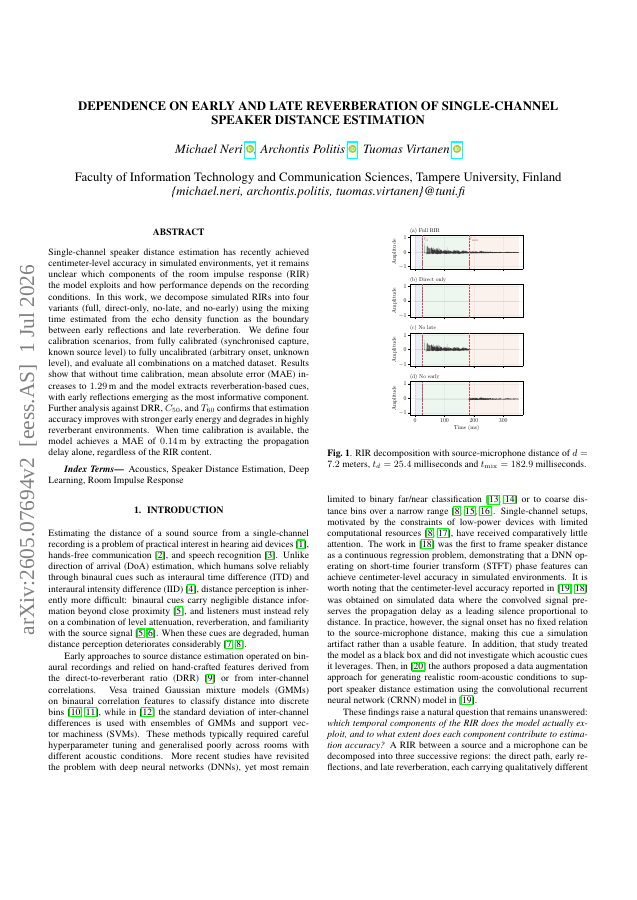
Single-channel speaker distance estimation has recently achieved centimeter-level accuracy in simulated environments, yet it remains unclear which components of the room impulse response (RIR) the model exploits and how performance depends on the recording conditions. In this work, we decompose simulated RIRs into four variants (full, direct-only, no-late, and no-early) using the mixing time estimated from the echo density function as the boundary between early reflections and late reverberation. We define four calibration scenarios, from fully calibrated (synchronised capture, known source level) to fully uncalibrated (arbitrary onset, unknown level), and evaluate all combinations on a matched dataset. Results show that without time calibration, mean absolute error (MAE) increases to 1.29 m and the model extracts reverberation-based cues, with early reflections emerging as the most informative component. Further analysis against DRR, C_{50}, and T_{60} confirms that estimation accuracy improves with stronger early energy and degrades in highly reverberant environments. When time calibration is available, the model achieves a MAE of 0.14 m by extracting the propagation delay alone, regardless of the RIR content.
Dependence on Early and Late Reverberation of Single-Channel Speaker Distance Estimation
Single-channel speaker distance estimation has recently achieved centimeter-level accuracy in simulated environments, yet it remains unclear which components of the room impulse response (RIR) the model exploits and how performance depends on the recording conditions.
- Preview
- Year
- 2026
- Hosting
- Full text hostedCC-BY-4.0
Cite
Notes
Only stored in your browser.
Attribution
- Abstract & full text
- arxiv.org/abs/2605.07694CC-BY-4.0
- TL;DR
- Semantic Scholar