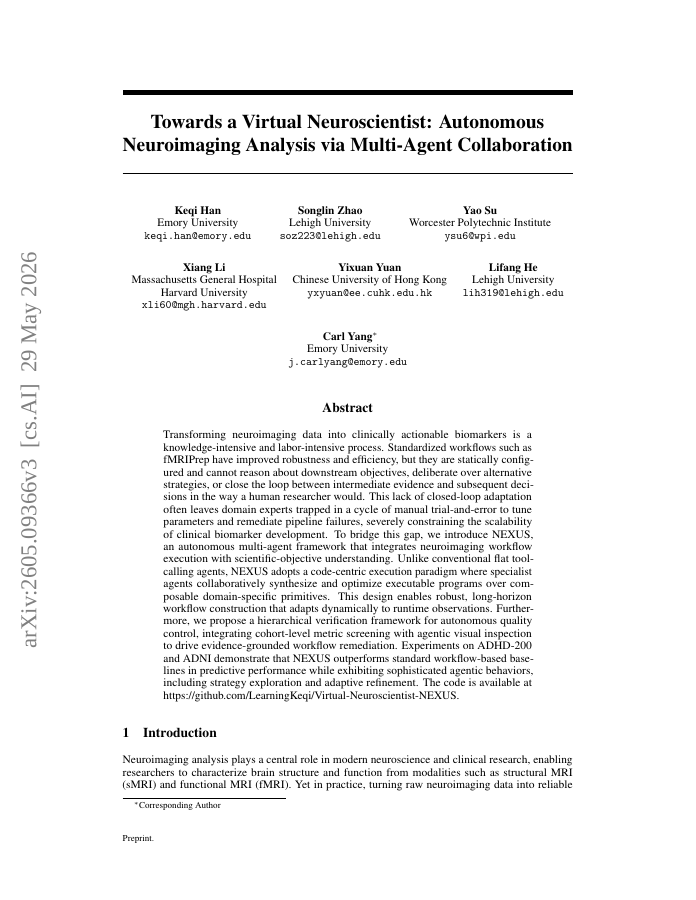
Transforming neuroimaging data into clinically actionable biomarkers is a knowledge-intensive and labor-intensive process. Standardized workflows such as fMRIPrep have improved robustness and efficiency, but they are statically configured and cannot reason about downstream objectives, deliberate over alternative strategies, or close the loop between intermediate evidence and subsequent decisions in the way a human researcher would. This lack of closed-loop adaptation often leaves domain experts trapped in a cycle of manual trial-and-error to tune parameters and remediate pipeline failures, severely constraining the scalability of clinical biomarker development. To bridge this gap, we introduce NEXUS, an autonomous multi-agent framework that integrates neuroimaging workflow execution with scientific-objective understanding. Unlike conventional flat toolcalling agents, NEXUS adopts a code-centric execution paradigm where specialist agents collaboratively synthesize and optimize executable programs over composable domain-specific primitives. This design enables robust, long-horizon workflow construction that adapts dynamically to runtime observations. Furthermore, we propose a hierarchical verification framework for autonomous quality control, integrating cohort-level metric screening with agentic visual inspection to drive evidence-grounded workflow remediation. Experiments on ADHD-200 and ADNI demonstrate that NEXUS outperforms standard workflow-based baselines in predictive performance while exhibiting sophisticated agentic behaviors, including strategy exploration and adaptive refinement. The code is available at https://github.com/LearningKeqi/Virtual-Neuroscientist-NEXUS.
Towards a Virtual Neuroscientist: Autonomous Neuroimaging Analysis via Multi-Agent Collaboration
Transforming neuroimaging data into clinically actionable biomarkers is a knowledge-intensive and labor-intensive process. Standardized workflows such as fMRIPrep have improved robustness and efficiency, but they are statically configured and cannot reason about downstream…
- Preview
- Year
- 2026
- Hosting
- Full text hostedCC-BY-4.0
Cite
Notes
Only stored in your browser.
Attribution
- Abstract & full text
- arxiv.org/abs/2605.09366CC-BY-4.0
- TL;DR
- Semantic Scholar