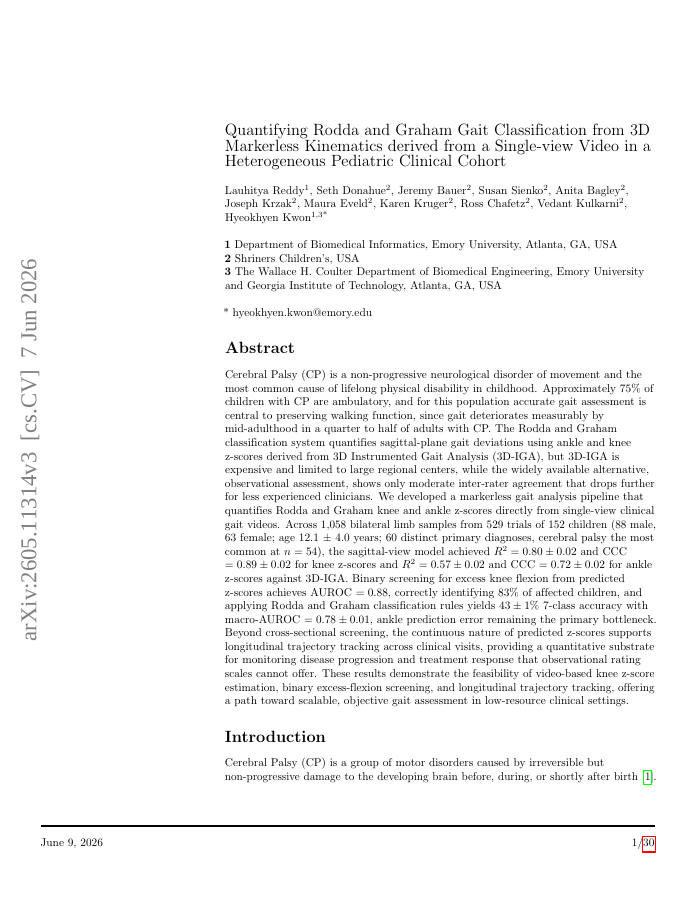
Cerebral Palsy (CP) is a neurological disorder of movement and the most common cause of lifelong physical disability in childhood. Approximately 75% of children with CP are ambulatory, and accurate gait assessment is central to preserving walking function, which deteriorates by mid-adulthood in a quarter to half of adults with CP. The Rodda and Graham classification system quantifies sagittal-plane gait deviations using ankle and knee z-scores derived from 3D Instrumented Gait Analysis (3D-IGA), but 3D-IGA is expensive and limited to specialized centers, while observational assessment shows only moderate inter-rater agreement. We developed a markerless gait analysis pipeline that quantifies Rodda and Graham knee and ankle z-scores directly from single-view clinical gait videos. Across 1,058 bilateral limb samples from 529 trials of 152 children (88 male, 63 female; age 12.1 \pm 4.0 years; 60 distinct primary diagnoses, cerebral palsy the most common at n=54), the sagittal-view model achieved R^2 = 0.80 \pm 0.02 and CCC = 0.89 \pm 0.02 for knee z-scores and R^2 = 0.57 \pm 0.02 and CCC = 0.72 \pm 0.02 for ankle z-scores against 3D-IGA. Binary screening for excess knee flexion achieves AUROC = 0.88, correctly identifying 83% of affected children, and applying Rodda and Graham rules yields 43 \pm 1% 7-class accuracy with macro-AUROC = 0.78 \pm 0.01, ankle prediction error remaining the primary bottleneck. Beyond cross-sectional screening, continuous z-scores support longitudinal trajectory tracking across visits, providing a quantitative substrate for monitoring disease progression and treatment response unavailable from observational scales. These results demonstrate the feasibility of video-based z-score estimation, excess-flexion screening, and longitudinal trajectory tracking as a path toward scalable, objective gait assessment in low-resource clinical settings.
Quantifying Rodda and Graham Gait Classification from 3D Markerless Kinematics derived from a Single-view Video in a Heterogeneous Pediatric Clinical Cohort
Cerebral Palsy (CP) is a neurological disorder of movement and the most common cause of lifelong physical disability in childhood. Approximately 75% of children with CP are ambulatory, and accurate gait assessment is central to preserving walking function, which deteriorates by…
- Preview
- Year
- 2026
- Hosting
- Excerpt onlyCC-BY-NC-4.0
Cite
Notes
Only stored in your browser.
Attribution
- Abstract & full text
- arxiv.org/abs/2605.11314CC-BY-NC-4.0
- TL;DR
- Semantic Scholar