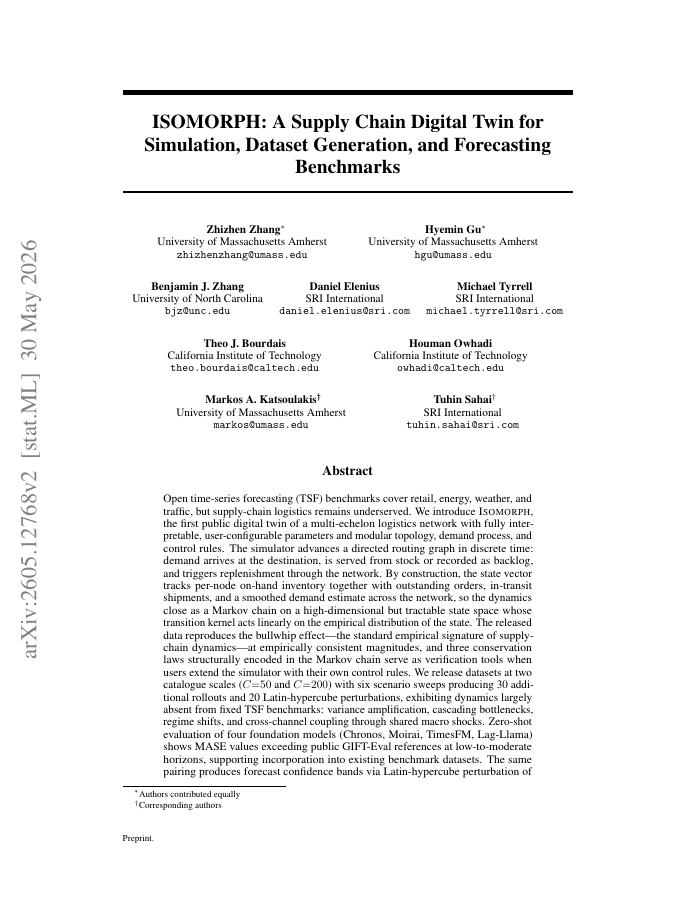
Open time-series forecasting (TSF) benchmarks cover retail, energy, weather, and traffic, but supply-chain logistics remains underserved. We introduce ISOMORPH, the first public digital twin of a multi-echelon logistics network with interpretable, user-configurable parameters and modular topology, demand, and control rules. The simulator advances a directed routing graph in discrete time: demand is served from inventory or recorded as backlog and triggers replenishment throughout the network. The state tracks inventory, outstanding orders, in-transit shipments, and a smoothed demand estimate, yielding Markovian dynamics on a tractable state space. The released data reproduces the bullwhip effect at empirically consistent magnitudes, while three conservation laws provide verification tools for simulator extensions. We release datasets at two catalogue scales ($C=50$ and $C=200$), six scenario sweeps, and 20 Latin-hypercube perturbations. These datasets exhibit dynamics largely absent from fixed TSF benchmarks, including variance amplification, cascading bottlenecks, regime shifts, and cross-channel coupling through shared macro shocks. Zero-shot evaluation of four foundation models (Chronos, Moirai, TimesFM, and Lag-Llama) yields MASE values exceeding public GIFT-Eval references at low-to-moderate horizons, supporting incorporation into existing benchmark suites. The same models provide forecast confidence bands through Latin-hypercube perturbations of demand-side parameters, enabling forward uncertainty quantification (UQ) unavailable on standard TSF datasets and demonstrating that foundation models can serve as fast surrogates for digital-twin-based UQ. Code (MIT): https://github.com/tuhinsahai/ISOMORPH. Interactive demo: https://huggingface.co/spaces/HyeminGu/ISOMORPH-demo.
ISOMORPH: A Supply Chain Digital Twin for Simulation, Dataset Generation, and Forecasting Benchmarks
Open time-series forecasting (TSF) benchmarks cover retail, energy, weather, and traffic, but supply-chain logistics remains underserved. We introduce ISOMORPH, the first public digital twin of a multi-echelon logistics network with interpretable, user-configurable parameters…
- Preview
- Year
- 2026
- Hosting
- Abstract onlyARXIV-DEFAULT
Cite
Notes
Only stored in your browser.
Attribution
- Abstract & full text
- arxiv.org/abs/2605.12768ARXIV-DEFAULT
- TL;DR
- Semantic Scholar