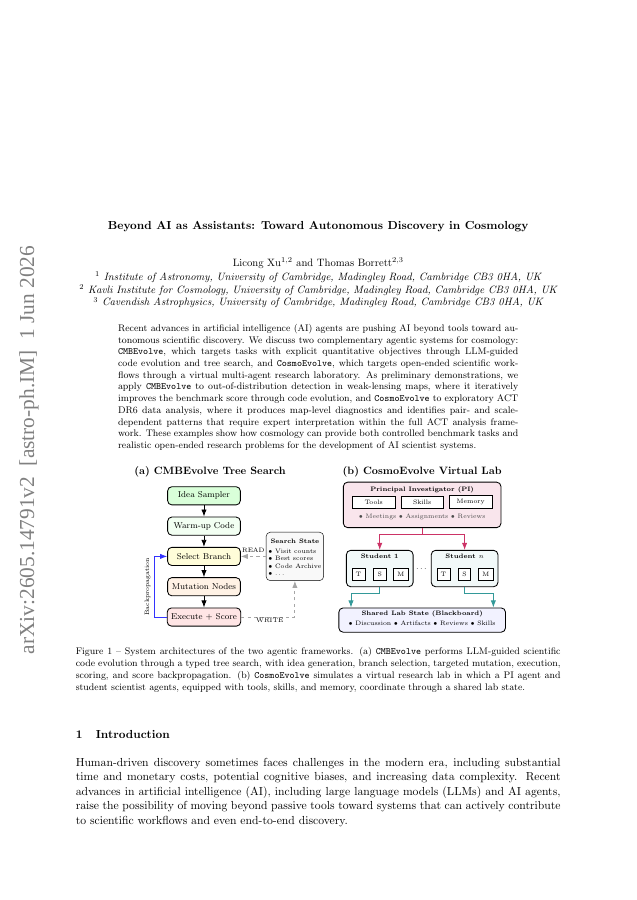
Recent advances in artificial intelligence (AI) agents are pushing AI beyond tools toward autonomous scientific discovery. We discuss two complementary agentic systems for cosmology: CMBEvolve, which targets tasks with explicit quantitative objectives through LLM-guided code evolution and tree search, and CosmoEvolve, which targets open-ended scientific workflows through a virtual multi-agent research laboratory. As preliminary demonstrations, we apply CMBEvolve to out-of-distribution detection in weak-lensing maps, where it iteratively improves the benchmark score through code evolution, and CosmoEvolve to autonomous ACT DR6 data analysis, where it identifies non-trivial pair- and scale-dependent behaviour and produces analysis-grade diagnostics. These examples show how cosmology can provide both controlled benchmark tasks and realistic open-ended research problems for the development of AI scientist systems.
Beyond AI as Assistants: Toward Autonomous Discovery in Cosmology
Recent advances in artificial intelligence (AI) agents are pushing AI beyond tools toward autonomous scientific discovery. We discuss two complementary agentic systems for cosmology: \texttt{CMBEvolve}, which targets tasks with explicit quantitative objectives through LLM-guided…
- Preview
- Year
- 2026
- Hosting
- Full text hostedCC-BY-4.0
Cite
Notes
Only stored in your browser.
Attribution
- Abstract & full text
- arxiv.org/abs/2605.14791CC-BY-4.0
- TL;DR
- Semantic Scholar