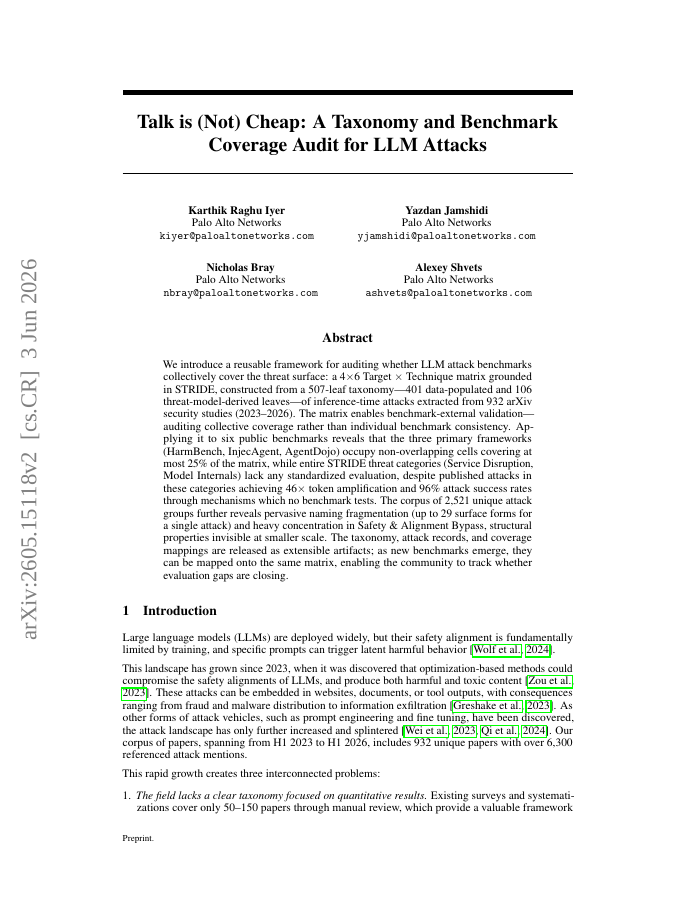
We introduce a reusable framework for auditing whether LLM attack benchmarks collectively cover the threat surface: a 4\times6 Target \times Technique matrix grounded in STRIDE, constructed from a 507-leaf taxonomy -- 401 data-populated and 106 threat-model-derived leaves -- of inference-time attacks extracted from 932 arXiv security studies (2023--2026). The matrix enables benchmark-external validation -- auditing collective coverage rather than individual benchmark consistency. Applying it to six public benchmarks reveals that the three primary frameworks (HarmBench, InjecAgent, AgentDojo) occupy non-overlapping cells covering at most 25% of the matrix, while entire STRIDE threat categories (Service Disruption, Model Internals) lack any standardized evaluation, despite published attacks in these categories achieving 46\times token amplification and 96% attack success rates through mechanisms which no benchmark tests. The corpus of 2,521 unique attack groups further reveals pervasive naming fragmentation (up to 29 surface forms for a single attack) and heavy concentration in Safety & Alignment Bypass, structural properties invisible at smaller scale. The taxonomy, attack records, and coverage mappings are released as extensible artifacts; as new benchmarks emerge, they can be mapped onto the same matrix, enabling the community to track whether evaluation gaps are closing.
Talk is (Not) Cheap: A Taxonomy and Benchmark Coverage Audit for LLM Attacks
We introduce a reusable framework for auditing whether LLM attack benchmarks collectively cover the threat surface: a 4$\times$6 Target $\times$ Technique matrix grounded in STRIDE, constructed from a 507-leaf taxonomy -- 401 data-populated and 106 threat-model-derived leaves --…
- Preview
- Year
- 2026
- Hosting
- Full text hostedCC-BY-4.0
Cite
Notes
Only stored in your browser.
Attribution
- Abstract & full text
- arxiv.org/abs/2605.15118CC-BY-4.0
- TL;DR
- Semantic Scholar