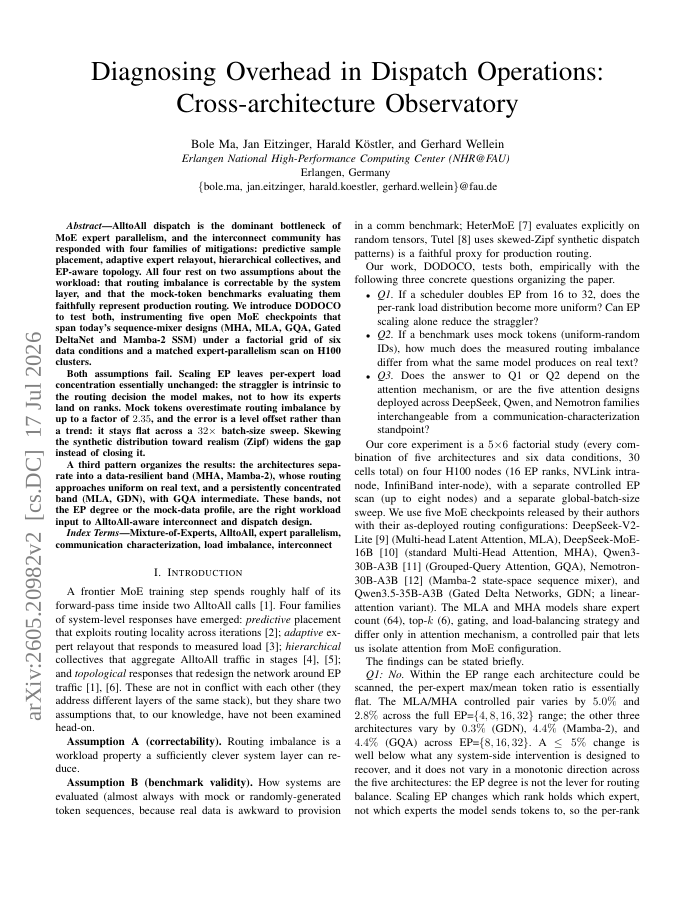
AlltoAll dispatch is the dominant bottleneck of MoE expert parallelism, and the interconnect community has responded with four families of mitigations: predictive sample placement, adaptive expert relayout, hierarchical collectives, and EP-aware topology. All four rest on two assumptions about the workload: that routing imbalance is correctable by the system layer, and that the mock-token benchmarks evaluating them faithfully represent production routing. We introduce DODOCO to test both, instrumenting five open MoE checkpoints that span today's sequence-mixer designs (MHA, MLA, GQA, Gated DeltaNet and Mamba-2 SSM) under a factorial grid of six data conditions and a matched expert-parallelism scan on H100 clusters. Both assumptions fail. Scaling EP leaves per-expert load concentration essentially unchanged: the straggler is intrinsic to the routing decision the model makes, not to how its experts land on ranks. Mock tokens overestimate routing imbalance by up to a factor of 2.35, and the error is a level offset rather than a trend: it stays flat across a 32\times batch-size sweep. Skewing the synthetic distribution toward realism (Zipf) widens the gap instead of closing it. A third pattern organizes the results: the architectures separate into a data-resilient band (MHA, Mamba-2), whose routing approaches uniform on real text, and a persistently concentrated band (MLA, GDN), with GQA intermediate. These bands, not the EP degree or the mock-data profile, are the right workload input to AlltoAll-aware interconnect and dispatch design.
Diagnosing Overhead in Dispatch Operations: Cross-architecture Observatory
AlltoAll dispatch is the dominant bottleneck of MoE expert parallelism, and the interconnect community has responded with four families of mitigations: predictive sample placement, adaptive expert relayout, hierarchical collectives, and EP-aware topology.
- Preview
- Year
- 2026
- Hosting
- Full text hostedCC-BY-4.0
Cite
Notes
Only stored in your browser.
Attribution
- Abstract & full text
- arxiv.org/abs/2605.20982CC-BY-4.0
- TL;DR
- Semantic Scholar