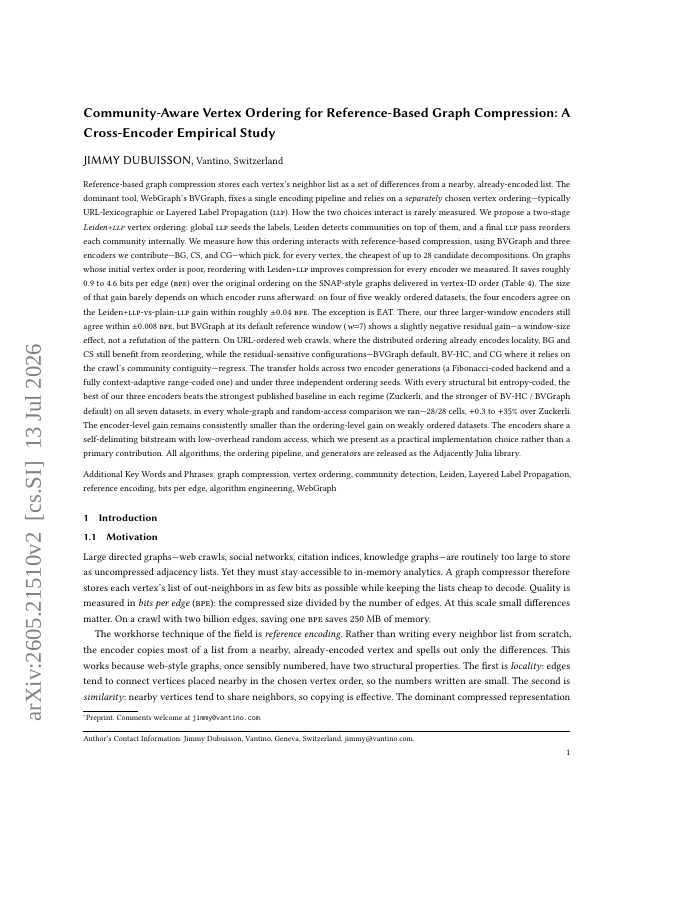
Reference-based graph compression encodes each vertex's neighbor list as differences from a nearby encoded list. WebGraph's BVGraph fixes a single encoding pipeline and relies on a separately chosen vertex ordering -- typically URL-lexicographic or Layered Label Propagation (LLP). Their interaction is rarely measured. We propose a two-stage Leiden+LLP ordering: global LLP seeds labels, Leiden detects communities, and a final LLP pass reorders each community internally. We study how it interacts with reference-based compression, using BVGraph and three encoders we contribute -- BG, CS, and CG -- each picking, per vertex, the cheapest of up to 28 candidate decompositions. On graphs with poor initial vertex order, reordering with Leiden+LLP improves compression for every encoder measured, saving 0.9 to 4.6 bits per edge (bpe) over the original order on SNAP-style graphs delivered in vertex-ID order. The gain barely depends on the encoder: on four of five weakly ordered datasets, the four encoders agree on the Leiden+LLP-vs-plain-LLP gain within about +/- 0.04 bpe. On URL-ordered web crawls, where the ordering already encodes locality, BG and CS still benefit, while residual-sensitive configurations (BVGraph default, BV-HC, and CG relying on community contiguity) regress. The transfer holds across two encoder generations (Fibonacci-coded and fully context-adaptive range-coded) and three ordering seeds. With every structural bit entropy-coded, the best of our three encoders beats the strongest published baseline in each regime (Zuckerli, and the stronger of BV-HC / BVGraph default) on all seven datasets in every whole-graph and random-access comparison -- 28/28 cells, +0.3 to +35% over Zuckerli -- with the encoder-level gain consistently smaller than the ordering-level gain. All algorithms, the ordering pipeline, and generators are released as the Adjacently Julia library.
Community-Aware Vertex Ordering for Reference-Based Graph Compression: A Cross-Encoder Empirical Study
Reference-based graph compression encodes each vertex's neighbor list as differences from a nearby encoded list. WebGraph's BVGraph fixes a single encoding pipeline and relies on a separately chosen vertex ordering -- typically URL-lexicographic or Layered Label Propagation…
- Preview
- Year
- 2026
- Hosting
- Abstract onlyARXIV-DEFAULT
Cite
Notes
Only stored in your browser.
Attribution
- Abstract & full text
- arxiv.org/abs/2605.21510ARXIV-DEFAULT
- TL;DR
- Semantic Scholar