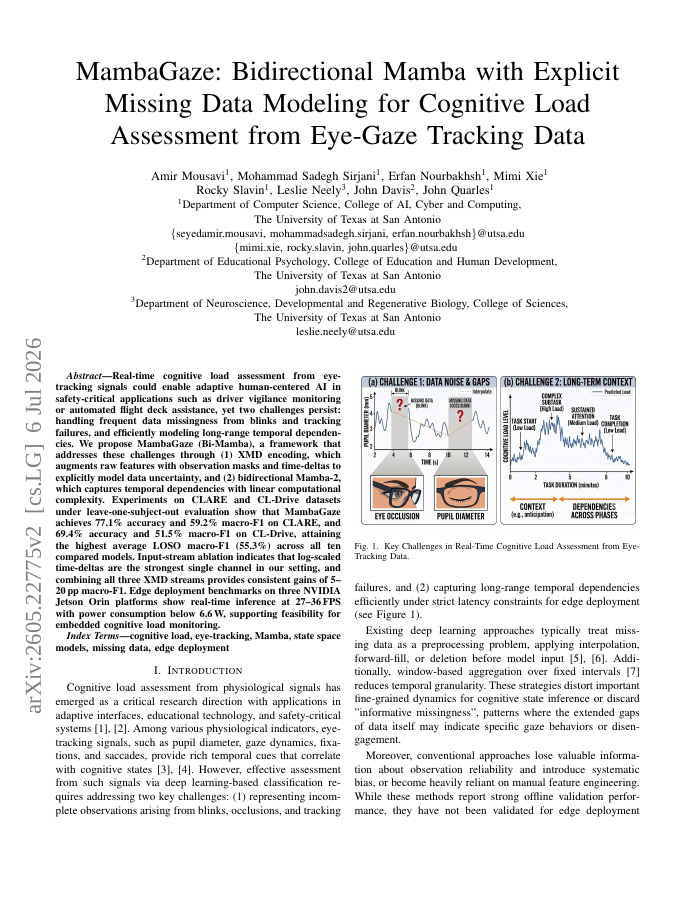
Real-time cognitive load assessment from eye-tracking signals could enable adaptive human-centered AI in safety-critical applications such as driver vigilance monitoring or automated flight deck assistance, yet two challenges persist: handling frequent data missingness from blinks and tracking failures, and efficiently modeling long-range temporal dependencies. We propose MambaGaze (Bi-Mamba), a framework that addresses these challenges through (1) XMD encoding, which augments raw features with observation masks and time-deltas to explicitly model data uncertainty, and (2) bidirectional Mamba-2, which captures temporal dependencies with linear computational complexity. Experiments on CLARE and CL-Drive datasets under leave-one-subject-out evaluation show that MambaGaze achieves 77.1% accuracy and 59.2% macro-F1 on CLARE, and 69.4% accuracy and 51.5% macro-F1 on CL-Drive, attaining the highest average LOSO macro-F1 (55.3%) across all ten compared models. Input-stream ablation indicates that log-scaled time-deltas are the strongest single channel in our setting, and combining all three XMD streams provides consistent gains of 5--20,pp macro-F1. Edge deployment benchmarks on three NVIDIA Jetson Orin platforms show real-time inference at 27--36,FPS with power consumption below 6.6,W, supporting feasibility for embedded cognitive load monitoring.
MambaGaze: Bidirectional Mamba with Explicit Missing Data Modeling for Cognitive Load Assessment from Eye-Gaze Tracking Data
Real-time cognitive load assessment from eye-tracking signals could enable adaptive human-centered AI in safety-critical applications such as driver vigilance monitoring or automated flight deck assistance, yet two challenges persist: handling frequent data missingness from…
- Preview
- Year
- 2026
- Hosting
- Excerpt onlyCC-BY-NC-SA-4.0
Cite
Notes
Only stored in your browser.
Attribution
- Abstract & full text
- arxiv.org/abs/2605.22775CC-BY-NC-SA-4.0
- TL;DR
- Semantic Scholar