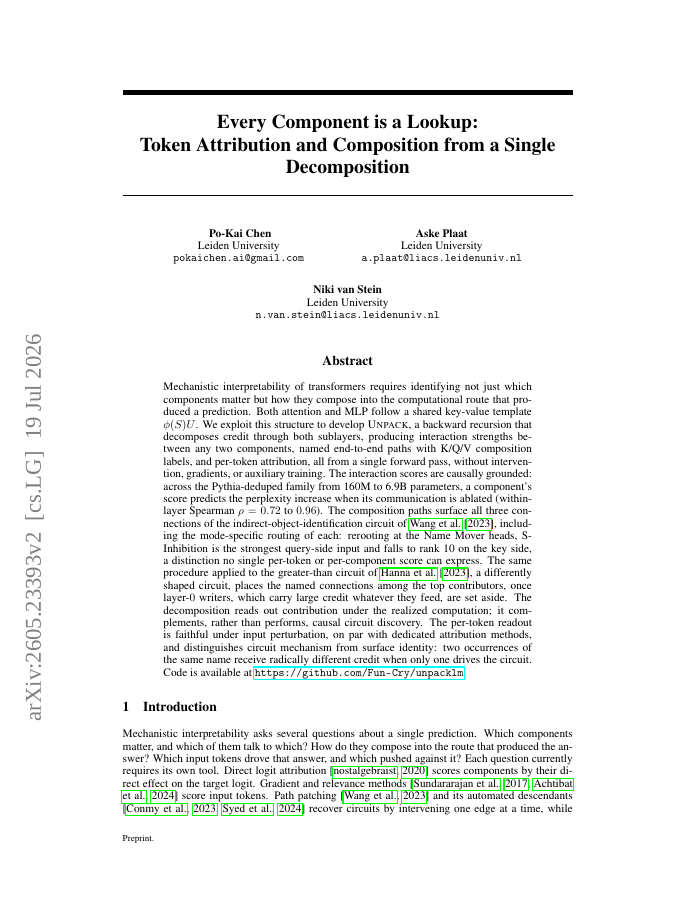
Mechanistic interpretability of transformers requires identifying not just which components matter but how they compose into the computational route that produced a prediction. Both attention and MLP follow a shared key-value template ϕ(S)U. We exploit this structure to develop Unpack, a backward recursion that decomposes credit through both sublayers, producing interaction strengths between any two components, named end-to-end paths with K/Q/V composition labels, and per-token attribution, all from a single forward pass, without intervention, gradients, or auxiliary training. The interaction scores are causally grounded: across the Pythia-deduped family from 160M to 6.9B parameters, a component's score predicts the perplexity increase when its communication is ablated (within-layer Spearman ρ= 0.72 to 0.96). The composition paths surface all three connections of the indirect-object-identification circuit of Wang et al. (2023), including the mode-specific routing of each: rerooting at the Name Mover heads, S-Inhibition is the strongest query-side input and falls to rank 10 on the key side, a distinction no single per-token or per-component score can express. The same procedure applied to the greater-than circuit of Hanna et al. (2023), a differently shaped circuit, places the named connections among the top contributors, once layer-0 writers, which carry large credit whatever they feed, are set aside. The decomposition reads out contribution under the realized computation; it complements, rather than performs, causal circuit discovery. The per-token readout is faithful under input perturbation, on par with dedicated attribution methods, and distinguishes circuit mechanism from surface identity: two occurrences of the same name receive radically different credit when only one drives the circuit. Code is available at https://github.com/Fun-Cry/unpacklm.
Every Component is a Lookup: Token Attribution and Composition from a Single Decomposition
Mechanistic interpretability of transformers requires identifying not just which components matter but how they compose into the computational route that produced a prediction. Both attention and MLP follow a shared key-value template $ϕ(S)U$.
- Preview
- Year
- 2026
- Hosting
- Abstract onlyARXIV-DEFAULT
Cite
Notes
Only stored in your browser.
Attribution
- Abstract & full text
- arxiv.org/abs/2605.23393ARXIV-DEFAULT
- TL;DR
- Semantic Scholar