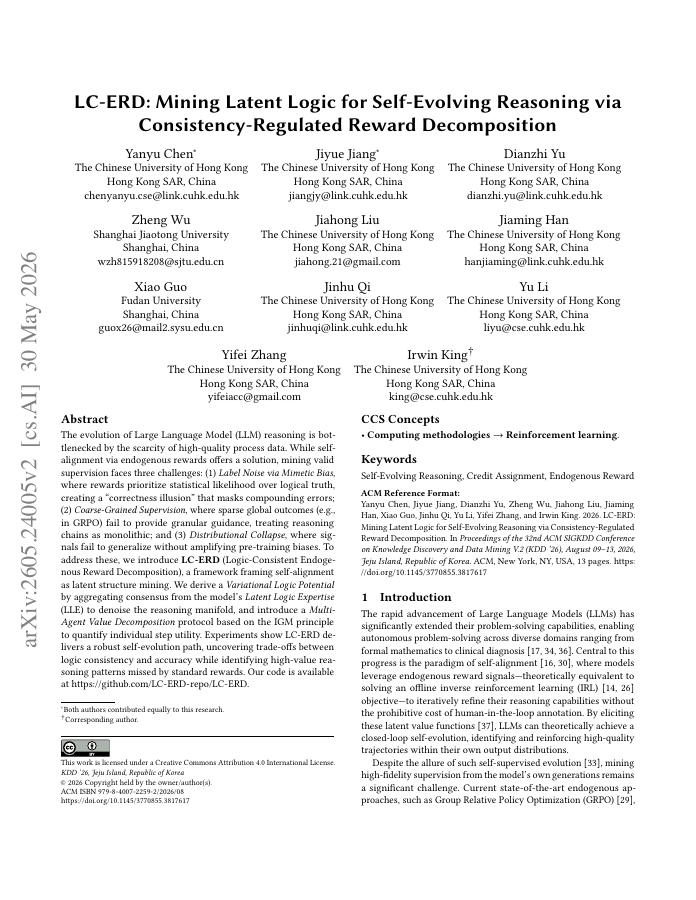
The evolution of Large Language Model (LLM) reasoning is bottlenecked by the scarcity of high-quality process data. While self-alignment via endogenous rewards offers a solution, mining valid supervision faces three challenges: (1) Label Noise via Mimetic Bias, where rewards prioritize statistical likelihood over logical truth, creating a "correctness illusion" that masks compounding errors; (2) Coarse-Grained Supervision, where sparse global outcomes (e.g., in GRPO) fail to provide granular guidance, treating reasoning chains as monolithic; and (3) Distributional Collapse, where signals fail to generalize without amplifying pre-training biases. To address these, we introduce LC-ERD (Logic-Consistent Endogenous Reward Decomposition), a framework framing self-alignment as latent structure mining. We derive a Variational Logic Potential by aggregating consensus from the model's Latent Logic Expertise (LLE) to denoise the reasoning manifold, and introduce a Multi-Agent Value Decomposition protocol based on the IGM principle to quantify individual step utility. Experiments show LC-ERD delivers a robust self-evolution path, uncovering trade-offs between logic consistency and accuracy while identifying high-value reasoning patterns missed by standard rewards. Our code is available at https://github.com/LC-ERD-repo/LC-ERD.
LC-ERD: Mining Latent Logic for Self-Evolving Reasoning via Consistency-Regulated Reward Decomposition
The evolution of Large Language Model (LLM) reasoning is bottlenecked by the scarcity of high-quality process data. While self-alignment via endogenous rewards offers a solution, mining valid supervision faces three challenges: (1) Label Noise via Mimetic Bias, where rewards…
- Preview
- Year
- 2026
- Hosting
- Abstract onlyARXIV-DEFAULT
Cite
Notes
Only stored in your browser.
Attribution
- Abstract & full text
- arxiv.org/abs/2605.24005ARXIV-DEFAULT
- TL;DR
- Semantic Scholar