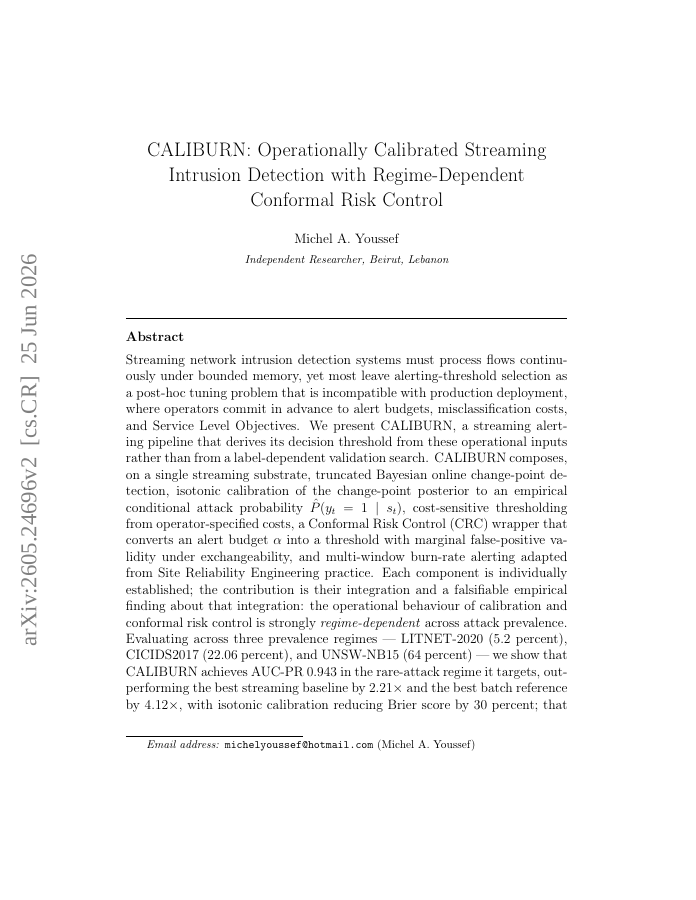
Streaming intrusion detection systems must process flows continuously under bounded memory, yet most leave alerting-threshold selection as a post-hoc tuning problem incompatible with production, where operators commit in advance to alert budgets, misclassification costs, and Service Level Objectives. We present CALIBURN, a streaming alerting pipeline that derives its decision threshold from these operational inputs rather than a label-dependent search. CALIBURN composes five layers on one streaming substrate: truncated Bayesian online change-point detection; isotonic calibration of the posterior to a conditional attack probability; cost-sensitive thresholding from operator costs; a Conformal Risk Control (CRC) wrapper mapping an alert budget alpha to a false-positive-bounded threshold under exchangeability; and multi-window burn-rate alerting from Site Reliability Engineering. Each layer is established; the contribution is the integration and a falsifiable finding about it: the behaviour of calibration and conformal risk control is strongly regime-dependent across attack prevalence. Across three regimes -- LITNET-2020 (5.2%), CICIDS2017 (22%), UNSW-NB15 (64%) -- CALIBURN reaches AUC-PR 0.943 in the rare-attack regime it targets, beating the best streaming baseline by 2.21x and the best batch reference by 4.12x, with isotonic calibration cutting Brier score 30%; it stays strongest among streaming methods at moderate prevalence; and all converge to the prevalence floor under base-rate inversion. A TTL-feature ablation shows this high-prevalence collapse is intrinsic to streaming, not a dataset artifact. We further identify two mechanisms -- a theoretical CRC overshoot 2B/(n0+1) and an empirical-density degeneracy -- collapsing conformal alerting at very small alpha, and propose both as pre-deployment checks. Code and artifacts: Apache 2.0, Zenodo DOI 10.5281/zenodo.20074590.
CALIBURN: Operationally Calibrated Streaming Intrusion Detection with Regime-Dependent Conformal Risk Control
Streaming intrusion detection systems must process flows continuously under bounded memory, yet most leave alerting-threshold selection as a post-hoc tuning problem incompatible with production, where operators commit in advance to alert budgets, misclassification costs, and…
- Preview
- Year
- 2026
- Hosting
- Full text hostedCC-BY-4.0
Cite
Notes
Only stored in your browser.
Attribution
- Abstract & full text
- arxiv.org/abs/2605.24696CC-BY-4.0
- TL;DR
- Semantic Scholar