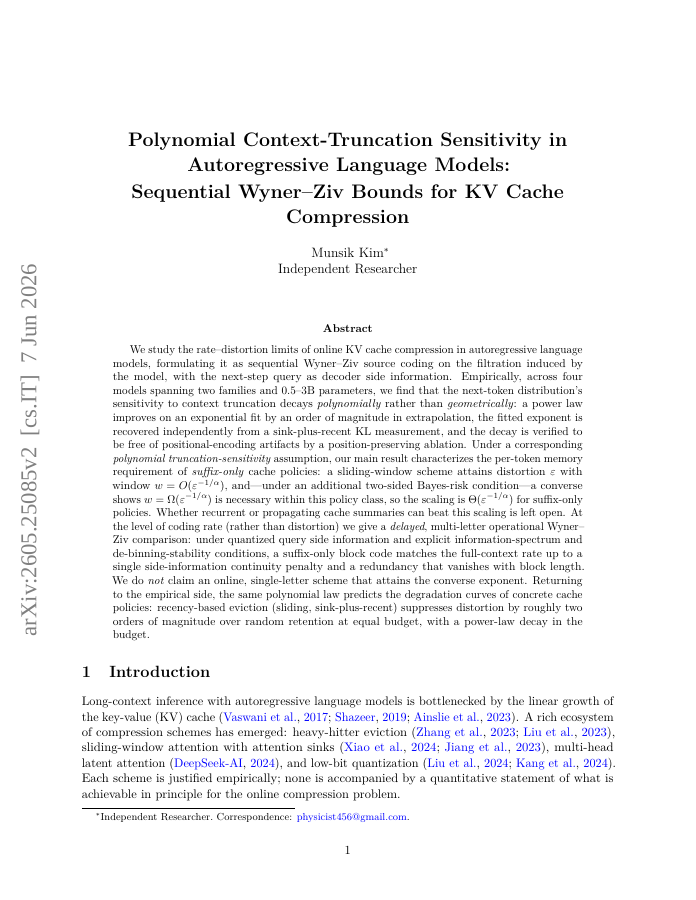
We study the rate-distortion limits of online KV cache compression in autoregressive language models, formulating it as sequential Wyner-Ziv source coding on the filtration induced by the model, with the next-step query as decoder side information. Empirically, across four models spanning two families and 0.5-3B parameters, we find that the next-token distribution's sensitivity to context truncation decays polynomially rather than geometrically: a power law improves on an exponential fit by an order of magnitude in extrapolation, the fitted exponent is recovered independently from a sink-plus-recent KL measurement, and the decay is verified to be free of positional-encoding artifacts by a position-preserving ablation. Under a corresponding polynomial truncation-sensitivity assumption, our main result characterizes the per-token memory requirement of suffix-only cache policies: a sliding-window scheme attains distortion \varepsilon with window w = O(\varepsilon^{-1/α}), and -- under an additional two-sided Bayes-risk condition -- a converse shows w = Ω(\varepsilon^{-1/α}) is necessary within this policy class, so the scaling is Θ(\varepsilon^{-1/α}) for suffix-only policies. Whether recurrent or propagating cache summaries can beat this scaling is left open. An explicit block-Markov scheme achieves the upper bound; its rate-of-convergence exponent matches the converse under additional forward-decay and regularity hypotheses (not implied by truncation sensitivity alone), and differs by a factor of two otherwise. Empirically, the polynomial law predicts the degradation curves of concrete cache policies: recency-based eviction (sliding, sink-plus-recent) suppresses distortion by roughly two orders of magnitude over random retention at equal budget, with a power-law decay in the budget.
Polynomial Context-Truncation Sensitivity in Autoregressive Language Models: Sequential Wyner-Ziv Bounds for KV Cache Compression
We study the rate-distortion limits of online KV cache compression in autoregressive language models, formulating it as sequential Wyner-Ziv source coding on the filtration induced by the model, with the next-step query as decoder side information.
- Preview
- Year
- 2026
- Hosting
- Full text hostedCC-BY-4.0
Cite
Notes
Only stored in your browser.
Attribution
- Abstract & full text
- arxiv.org/abs/2605.25085CC-BY-4.0
- TL;DR
- Semantic Scholar