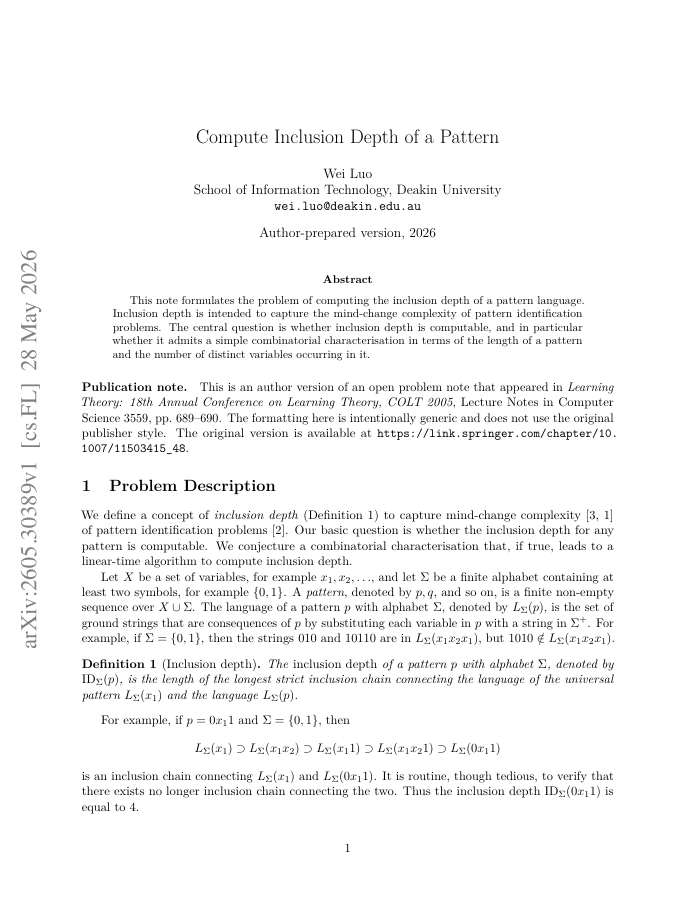
Pattern languages are a classical model in formal language theory and algorithmic learning theory. This note formulates the problem of computing the inclusion depth of a pattern language: the length of the longest strict inclusion chain from the universal pattern language to the language generated by a given pattern. Inclusion depth captures the mind-change complexity of pattern identification from positive data. The central open question is whether the inclusion depth ID_Sigma(p) is computable for every pattern p over every finite alphabet Sigma with at least two symbols, and whether it is computable in polynomial time. A simple conjectured formula, ID_Sigma(p) = 2|p| - #var(p) - 1, would imply a linear-time algorithm. The problem connects pattern language inclusion, combinatorics on words, language identification in the limit, and mind-change-bounded learning.
The Inclusion Depth of Pattern Languages: An Open Problem in Algorithmic Learning Theory
Pattern languages are a classical model in formal language theory and algorithmic learning theory. This note formulates the problem of computing the inclusion depth of a pattern language: the length of the longest strict inclusion chain from the universal pattern language to the…
- Preview
- Year
- 2026
- Hosting
- Full text hostedCC-BY-4.0
Cite
Notes
Only stored in your browser.
Attribution
- Abstract & full text
- arxiv.org/abs/2605.30389CC-BY-4.0
- TL;DR
- Semantic Scholar