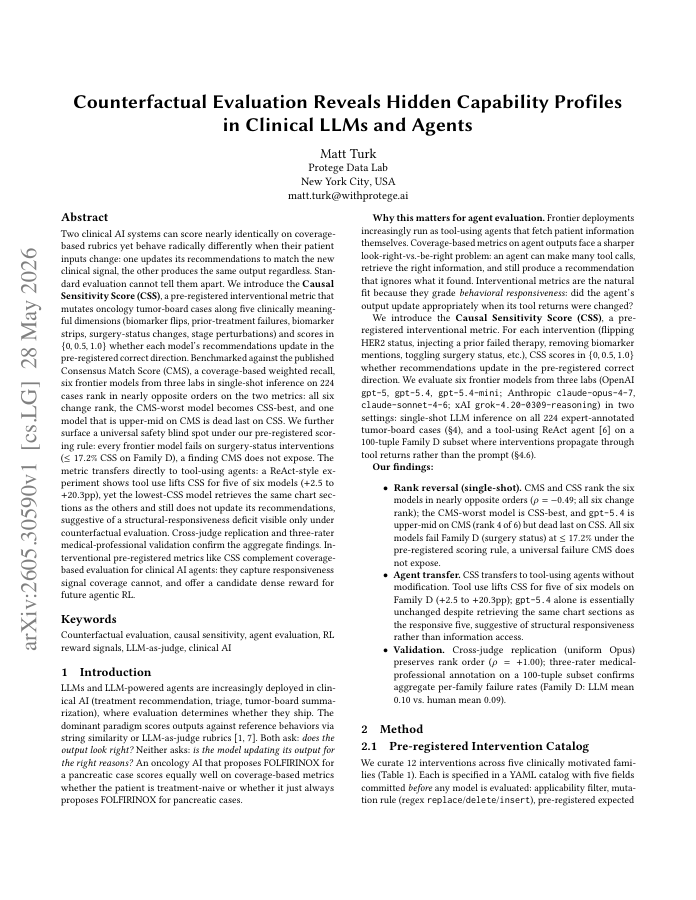
Two clinical AI systems can score nearly identically on coverage-based rubrics yet behave radically differently when their patient inputs change: one updates its recommendations to match the new clinical signal, while the other produces the same output regardless. We introduce the Causal Sensitivity Score (CSS), a pre-registered interventional metric that mutates oncology tumor-board cases along five clinically meaningful dimensions - biomarker flips, prior-treatment failures, biomarker removals, surgery-status changes, and stage perturbations - and scores whether each model updates its recommendations in the pre-registered correct direction using a {0, 0.5, 1.0} scale. Benchmarked against the Consensus Match Score (CMS), a coverage-based weighted recall metric, six frontier models from three labs evaluated in single-shot inference across 224 cases rank in nearly opposite orders: all six models change rank, the CMS-worst model becomes CSS-best, and one upper-mid CMS model ranks last on CSS. We further surface a universal safety blind spot: every frontier model fails on surgery-status interventions (at most 17.2% CSS on Family D), a finding CMS does not expose. The metric also transfers to tool-using agents: in a ReAct-style experiment, tool use improves CSS for five of six models (+2.5 to +20.3 percentage points), yet the lowest-CSS model retrieves the same chart sections and still fails to update its recommendations - revealing a structural responsiveness deficit visible only under counterfactual evaluation. Cross-judge replication and three-rater medical-professional validation confirm the aggregate findings. Interventional pre-registered metrics like CSS complement coverage-based evaluation for clinical AI agents: they capture responsiveness that coverage metrics miss and offer a candidate dense reward signal for future agentic RL systems.
Counterfactual Evaluation Reveals Hidden Capability Profiles in Clinical LLMs and Agents
Two clinical AI systems can score nearly identically on coverage-based rubrics yet behave radically differently when their patient inputs change: one updates its recommendations to match the new clinical signal, while the other produces the same output regardless.
- Preview
- Year
- 2026
- Hosting
- Full text hostedCC-BY-4.0
Cite
Notes
Only stored in your browser.
Attribution
- Abstract & full text
- arxiv.org/abs/2605.30590CC-BY-4.0
- TL;DR
- Semantic Scholar