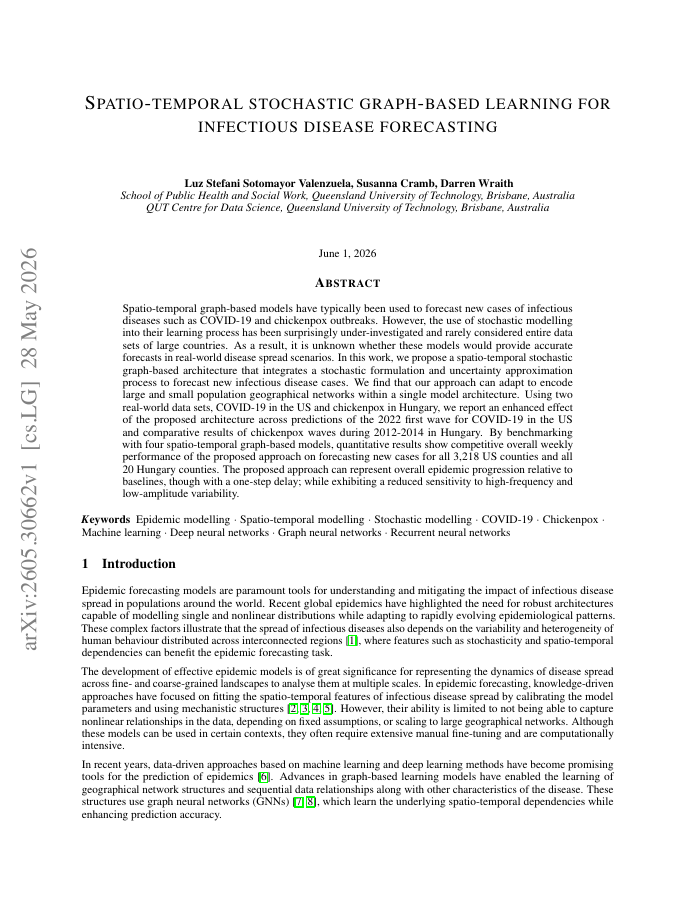
Spatio-temporal graph-based models have typically been used to forecast new cases of infectious diseases such as COVID-19 and chickenpox outbreaks. However, the use of stochastic modelling into their learning process has been surprisingly under-investigated and rarely considered entire data sets of large countries. As a result, it is unknown whether these models would provide accurate forecasts in real-world disease spread scenarios. In this work, we propose a spatio-temporal stochastic graph-based architecture that integrates a stochastic formulation and uncertainty approximation process to forecast new infectious disease cases. We find that our approach can adapt to encode large and small population geographical networks within a single model architecture. Using two real-world data sets, COVID-19 in the US and chickenpox in Hungary, we report an enhanced effect of the proposed architecture across predictions of the 2022 first wave for COVID-19 in the US and comparative results of chickenpox waves during 2012-2014 in Hungary. By benchmarking with four spatio-temporal graph-based models, quantitative results show competitive overall weekly performance of the proposed approach on forecasting new cases for all 3,218 US counties and all 20 Hungary counties. The proposed approach can represent overall epidemic progression relative to baselines, though with a one-step delay; while exhibiting a reduced sensitivity to high-frequency and low-amplitude variability.
Spatio-temporal stochastic graph-based learning for infectious disease forecasting
Spatio-temporal graph-based models have typically been used to forecast new cases of infectious diseases such as COVID-19 and chickenpox outbreaks. However, the use of stochastic modelling into their learning process has been surprisingly under-investigated and rarely considered…
- Preview
- Year
- 2026
- Hosting
- Full text hostedCC-BY-4.0
Cite
Notes
Only stored in your browser.
Attribution
- Abstract & full text
- arxiv.org/abs/2605.30662CC-BY-4.0
- TL;DR
- Semantic Scholar