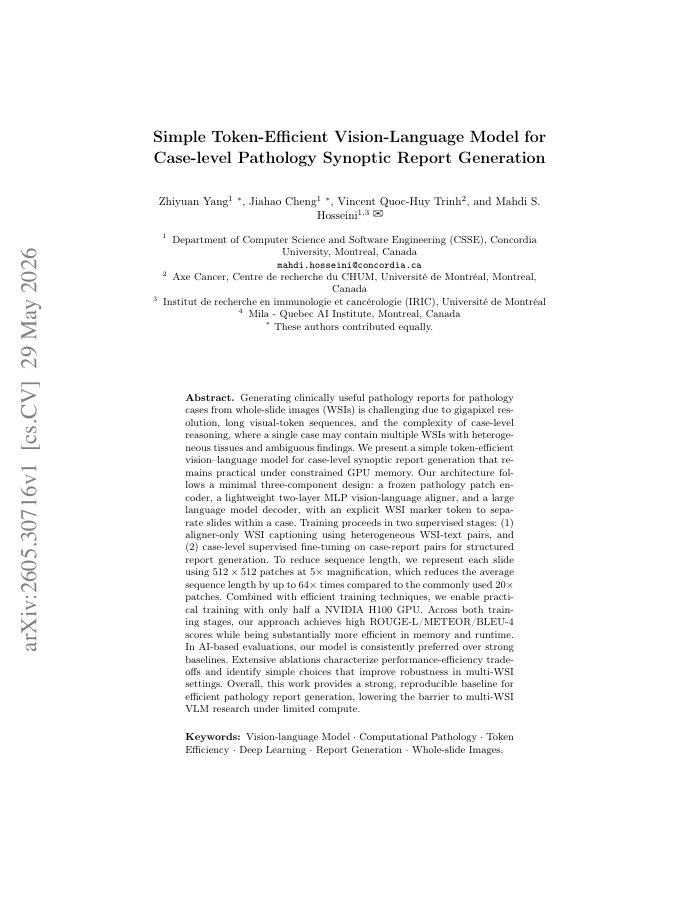
Generating clinically useful pathology reports for pathology cases from whole-slide images (WSIs) is challenging due to gigapixel resolution, long visual-token sequences, and the complexity of case-level reasoning, where a single case may contain multiple WSIs with heterogeneous tissues and ambiguous findings. We present a simple token-efficient vision--language model for case-level synoptic report generation that remains practical under constrained GPU memory. Our architecture follows a minimal three-component design: a frozen pathology patch encoder, a lightweight two-layer MLP vision-language aligner, and a large language model decoder, with an explicit WSI marker token to separate slides within a case. Training proceeds in two supervised stages: (1) aligner-only WSI captioning using heterogeneous WSI-text pairs, and (2) case-level supervised fine-tuning on case-report pairs for structured report generation. To reduce sequence length, we represent each slide using $512 \times 512$ patches at $5\times$ magnification, which reduces the average sequence length by up to $64\times$ times compared to the commonly used $20\times$ patches. Combined with efficient training techniques, we enable practical training with only half a NVIDIA H100 GPU. Across both training stages, our approach achieves high ROUGE-L/METEOR/BLEU-4 scores while being substantially more efficient in memory and runtime. In AI-based evaluations, our model is consistently preferred over strong baselines. Extensive ablations characterize performance-efficiency trade-offs and identify simple choices that improve robustness in multi-WSI settings. Overall, this work provides a strong, reproducible baseline for efficient pathology report generation, lowering the barrier to multi-WSI VLM research under limited compute.
Simple Token-Efficient Vision-Language Model for Case-level Pathology Synoptic Report Generation
Generating clinically useful pathology reports for pathology cases from whole-slide images (WSIs) is challenging due to gigapixel resolution, long visual-token sequences, and the complexity of case-level reasoning, where a single case may contain multiple WSIs with heterogeneous…
- Preview
- Year
- 2026
- Hosting
- Excerpt onlyCC-BY-NC-SA-4.0
Cite
Notes
Only stored in your browser.
Attribution
- Abstract & full text
- arxiv.org/abs/2605.30716CC-BY-NC-SA-4.0
- TL;DR
- Semantic Scholar