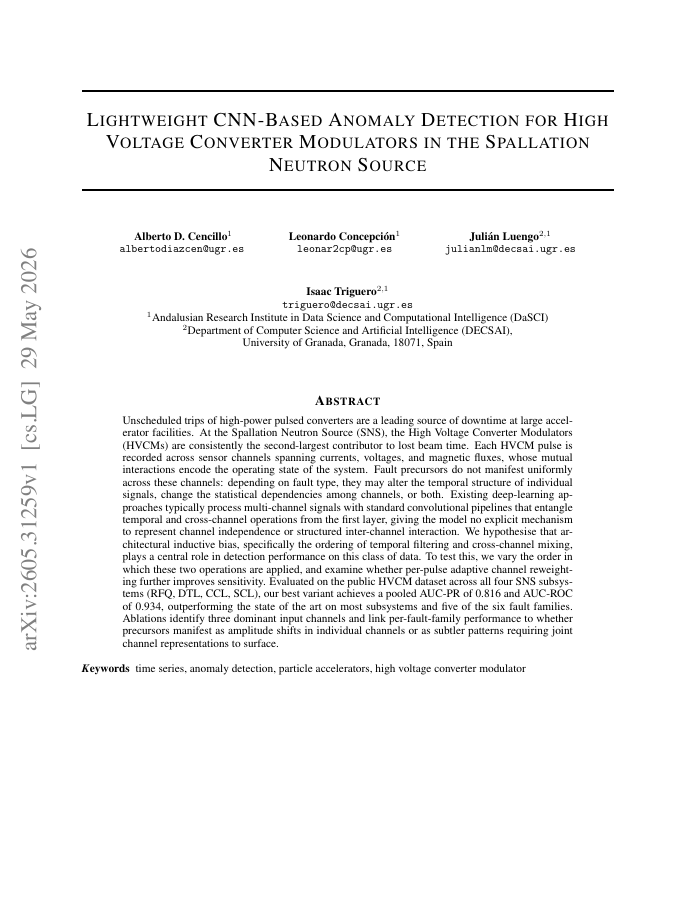
Unscheduled trips of high-power pulsed converters are a leading source of downtime at large accelerator facilities. At the Spallation Neutron Source (SNS), the High Voltage Converter Modulators (HVCMs) are consistently the second-largest contributor to lost beam time. Each HVCM pulse is recorded across sensor channels spanning currents, voltages, and magnetic fluxes, whose mutual interactions encode the operating state of the system. Fault precursors do not manifest uniformly across these channels: depending on fault type, they may alter the temporal structure of individual signals, change the statistical dependencies among channels, or both. Existing deep-learning approaches typically process multi-channel signals with standard convolutional pipelines that entangle temporal and cross-channel operations from the first layer, giving the model no explicit mechanism to represent channel independence or structured inter-channel interaction. We hypothesise that architectural inductive bias, specifically the ordering of temporal filtering and cross-channel mixing, plays a central role in detection performance on this class of data. To test this, we vary the order in which these two operations are applied, and examine whether per-pulse adaptive channel reweighting further improves sensitivity. Evaluated on the public HVCM dataset across all four SNS subsystems (RFQ, DTL, CCL, SCL), our best variant achieves a pooled AUC-PR of 0.816 and AUC-ROC of 0.934, outperforming the state of the art on most subsystems and five of the six fault families. Ablations identify three dominant input channels and link per-fault-family performance to whether precursors manifest as amplitude shifts in individual channels or as subtler patterns requiring joint channel representations to surface.
Lightweight CNN-Based Anomaly Detection for High Voltage Converter Modulators in the Spallation Neutron Source
Unscheduled trips of high-power pulsed converters are a leading source of downtime at large accelerator facilities. At the Spallation Neutron Source (SNS), the High Voltage Converter Modulators (HVCMs) are consistently the second-largest contributor to lost beam time.
- Preview
- Year
- 2026
- Hosting
- Full text hostedCC-BY-4.0
Cite
Notes
Only stored in your browser.
Attribution
- Abstract & full text
- arxiv.org/abs/2605.31259CC-BY-4.0
- TL;DR
- Semantic Scholar