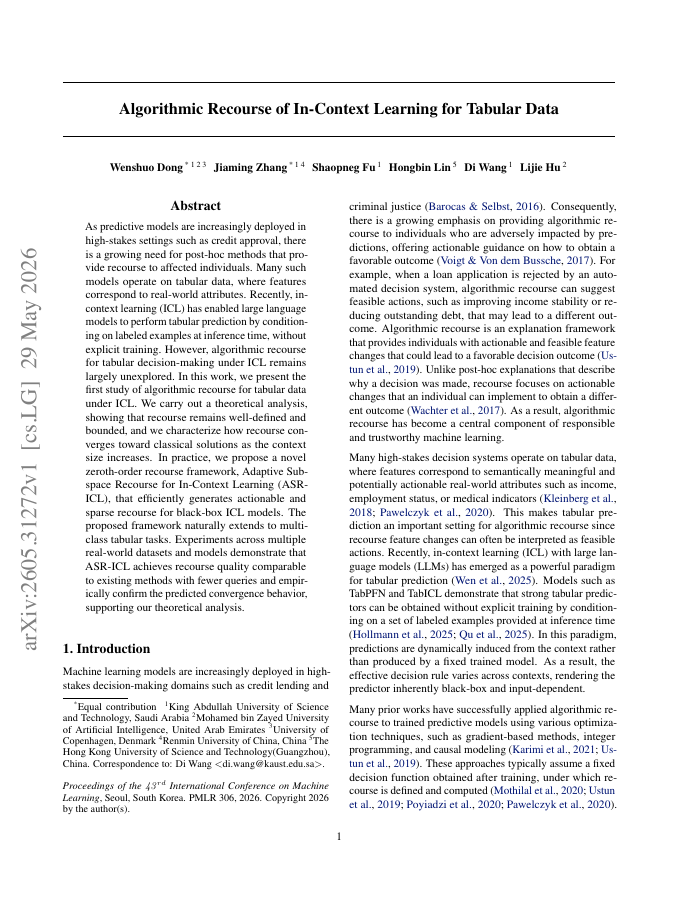
As predictive models are increasingly deployed in high-stakes settings such as credit approval, there is a growing need for post-hoc methods that provide recourse to affected individuals. Many such models operate on tabular data, where features correspond to real-world attributes. Recently, in-context learning (ICL) has enabled large language models to perform tabular prediction by conditioning on labeled examples at inference time, without explicit training. However, algorithmic recourse for tabular decision-making under ICL remains largely unexplored. In this work, we present the first study of algorithmic recourse for tabular data under ICL. We carry out a theoretical analysis, showing that recourse remains well-defined and bounded, and we characterize how recourse converges toward classical solutions as the context size increases. In practice, we propose a novel zeroth-order recourse framework, Adaptive Subspace Recourse for In-Context Learning (ASR-ICL), that efficiently generates actionable and sparse recourse for black-box ICL models. The proposed framework naturally extends to multi-class tabular tasks. Experiments across multiple real-world datasets and models demonstrate that ASR-ICL achieves recourse quality comparable to existing methods with fewer queries and empirically confirm the predicted convergence behavior, supporting our theoretical analysis.
Algorithmic Recourse of In-Context Learning for Tabular Data
As predictive models are increasingly deployed in high-stakes settings such as credit approval, there is a growing need for post-hoc methods that provide recourse to affected individuals.
- Preview
- Year
- 2026
- Hosting
- Full text hostedCC-BY-4.0
Cite
Notes
Only stored in your browser.
Attribution
- Abstract & full text
- arxiv.org/abs/2605.31272CC-BY-4.0
- TL;DR
- Semantic Scholar