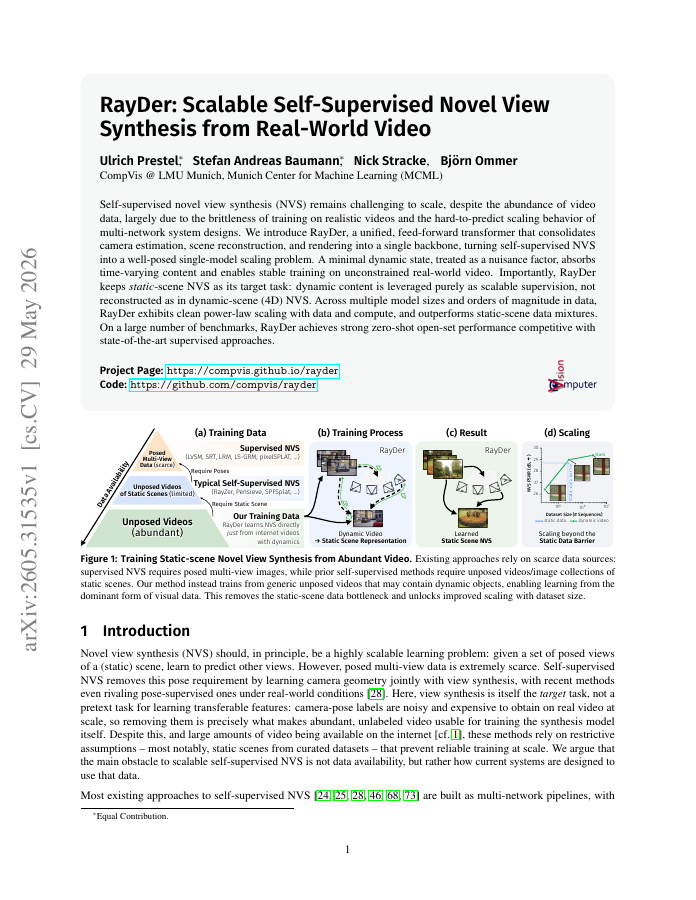
Self-supervised novel view synthesis (NVS) remains challenging to scale, despite the abundance of video data, largely due to the brittleness of training on realistic videos and the hard-to-predict scaling behavior of multi-network system designs. We introduce RayDer, a unified, feed-forward transformer that consolidates camera estimation, scene reconstruction, and rendering into a single backbone, turning self-supervised NVS into a well-posed single-model scaling problem. A minimal dynamic state, treated as a nuisance factor, absorbs time-varying content and enables stable training on unconstrained real-world video. Importantly, RayDer keeps static-scene NVS as its target task: dynamic content is leveraged purely as scalable supervision, not reconstructed as in dynamic-scene (4D) NVS. Across multiple model sizes and orders of magnitude in data, RayDer exhibits clean power-law scaling with data and compute, and outperforms static-scene data mixtures. On a large number of benchmarks, RayDer achieves strong zero-shot open-set performance competitive with state-of-the-art supervised approaches. Project Page: https://compvis.github.io/rayder
RayDer: Scalable Self-Supervised Novel View Synthesis from Real-World Video
Self-supervised novel view synthesis (NVS) remains challenging to scale, despite the abundance of video data, largely due to the brittleness of training on realistic videos and the hard-to-predict scaling behavior of multi-network system designs.
- Preview
- Year
- 2026
- Hosting
- Abstract onlyARXIV-DEFAULT
Cite
Notes
Only stored in your browser.
Attribution
- Abstract & full text
- arxiv.org/abs/2605.31535ARXIV-DEFAULT
- TL;DR
- Semantic Scholar