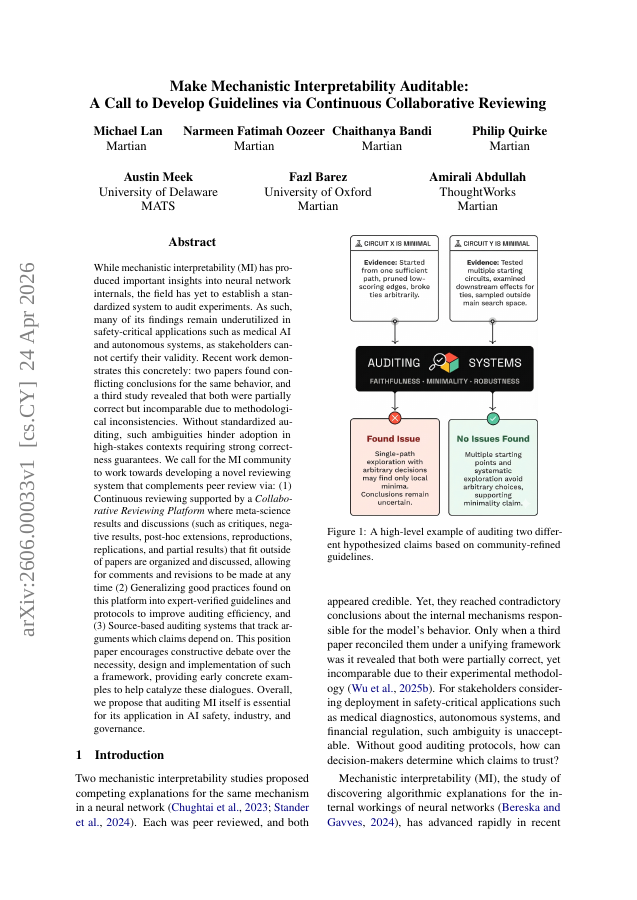
While mechanistic interpretability (MI) has produced important insights into neural network internals, the field has yet to establish a standardized system to audit experiments. As such, many of its findings remain underutilized in safety-critical applications such as medical AI and autonomous systems, as stakeholders cannot certify their validity. Recent work demonstrates this concretely: two papers found conflicting conclusions for the same behavior, and a third study revealed that both were partially correct but incomparable due to methodological inconsistencies. Without standardized auditing, such ambiguities hinder adoption in high-stakes contexts requiring strong correctness guarantees. We call for the MI community to work towards developing a novel reviewing system that complements peer review via: (1) Continuous reviewing supported by a Collaborative Reviewing Platform where meta-science results and discussions (such as critiques, negative results, post-hoc extensions, reproductions, replications, and partial results) that fit outside of papers are organized and discussed, allowing for comments and revisions to be made at any time (2) Generalizing good practices found on this platform into expert-verified guidelines and protocols to improve auditing efficiency, and (3) Source-based auditing systems that track arguments which claims depend on. This position paper encourages constructive debate over the necessity, design and implementation of such a framework, providing early concrete examples to help catalyze these dialogues. Overall, we propose that auditing MI itself is essential for its application in AI safety, industry, and governance.
Make Mechanistic Interpretability Auditable: A Call to Develop Guidelines via Continuous Collaborative Reviewing
While mechanistic interpretability (MI) has produced important insights into neural network internals, the field has yet to establish a standardized system to audit experiments.
- Preview
- Year
- 2026
- Hosting
- Full text hostedCC-BY-4.0
Cite
Notes
Only stored in your browser.
Attribution
- Abstract & full text
- arxiv.org/abs/2606.00033CC-BY-4.0
- TL;DR
- Semantic Scholar