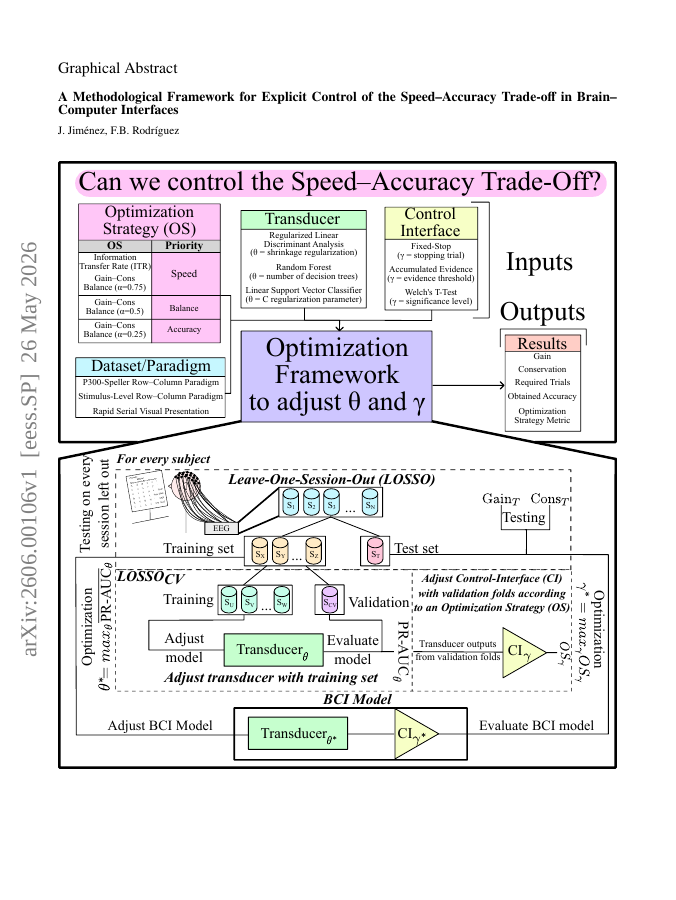
Brain-computer interfaces (BCIs) are limited by low signal-to-noise ratio in modalities such as electroencephalography, which requires multiple trials to reliably decode user intentions. This induces a speed-accuracy trade-off, whereby higher accuracy comes at the cost of speed. The speed-accuracy balance is application-dependent, motivating controllable trade-offs. Conventional metrics, such as the Information Transfer Rate, combine speed and accuracy obscuring their dependence and potentially introducing biases. In this study, we propose an evaluation framework independent of classifier, paradigm, and early-stopping strategy that separates speed and accuracy. We employ two measures, Gain (relative speed improvement) and Conservation (relative accuracy preservation), and combine them into a tunable Gain-Cons Balance controlled by α, regulating the speed-accuracy trade-off. The parameter adjusts the operating point without modifying the classifier, facilitating deployment across scenarios. The framework was evaluated on P300 event-related potential paradigms using public recordings from 63 subjects as well as multiple classifiers and early-stopping strategies to achieve distinct operating points in speed-accuracy and bitrate. Results show that tuning α yields fast, accurate, or balanced BCI behaviours, demonstrating explicit control of the speed-accuracy trade-off. The method supports subject-level performance prediction and improves explainability of BCI behaviour. Further analysis of the Information Transfer Rate reveals a systematic bias toward speed, explained by the proposed framework through the Gain and Conservation measurements. Overall, this work establishes the speed-accuracy trade-off as a controllable design variable validated on public P300-based paradigms, enabling transparent evaluation and application-specific optimization of BCIs.
A Methodological Framework for Explicit Control of the Speed-Accuracy Trade-off in Brain-Computer Interfaces
Brain-computer interfaces (BCIs) are limited by low signal-to-noise ratio in modalities such as electroencephalography, which requires multiple trials to reliably decode user intentions. This induces a speed-accuracy trade-off, whereby higher accuracy comes at the cost of speed.
- Preview
- Year
- 2026
- Hosting
- Abstract onlyARXIV-DEFAULT
Cite
Notes
Only stored in your browser.
Attribution
- Abstract & full text
- arxiv.org/abs/2606.00106ARXIV-DEFAULT
- TL;DR
- Semantic Scholar