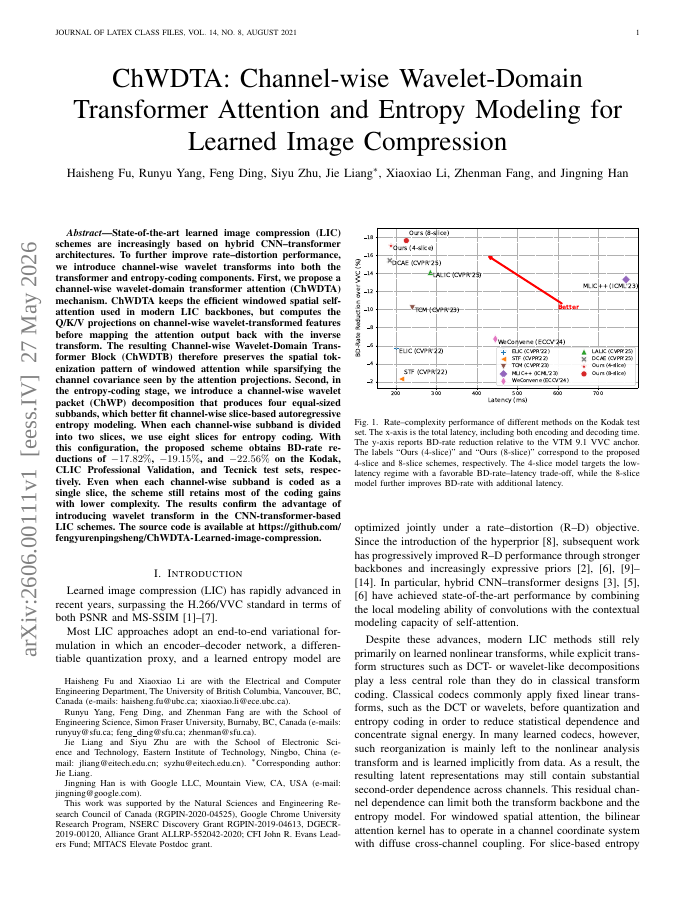
State-of-the-art learned image compression (LIC) schemes are increasingly based on hybrid CNN-transformer architectures. To further improve rate-distortion performance, we introduce channel-wise wavelet transforms into both the transformer and entropy-coding components. First, we propose a channel-wise wavelet-domain transformer attention (ChWDTA) mechanism. ChWDTA keeps the efficient windowed spatial self-attention used in modern LIC backbones, but computes the Q/K/V projections on channel-wise wavelet-transformed features before mapping the attention output back with the inverse transform. The resulting Channel-wise Wavelet-Domain Transformer Block (ChWDTB) therefore preserves the spatial tokenization pattern of windowed attention while sparsifying the channel covariance seen by the attention projections. Second, in the entropy-coding stage, we introduce a channel-wise wavelet packet (ChWP) decomposition that produces four equal-sized subbands, which better fit channel-wise slice-based autoregressive entropy modeling. When each channel-wise subband is divided into two slices, we use eight slices for entropy coding. With this configuration, the proposed scheme obtains BD-rate reductions of -17.82%, -19.15%, and -22.56% on the Kodak, CLIC Professional Validation, and Tecnick test sets, respectively. Even when each channel-wise subband is coded as a single slice, the scheme still retains most of the coding gains with lower complexity. The results confirm the advantage of introducing wavelet transform in CNN-transformer-based LIC schemes.
ChWDTA: Channel-wise Wavelet-Domain Transformer Attention and Entropy Modeling for Learned Image Compression
State-of-the-art learned image compression (LIC) schemes are increasingly based on hybrid CNN-transformer architectures. To further improve rate-distortion performance, we introduce channel-wise wavelet transforms into both the transformer and entropy-coding components.
- Preview
- Year
- 2026
- Hosting
- Abstract onlyARXIV-DEFAULT
Cite
Notes
Only stored in your browser.
Attribution
- Abstract & full text
- arxiv.org/abs/2606.00111ARXIV-DEFAULT
- TL;DR
- Semantic Scholar