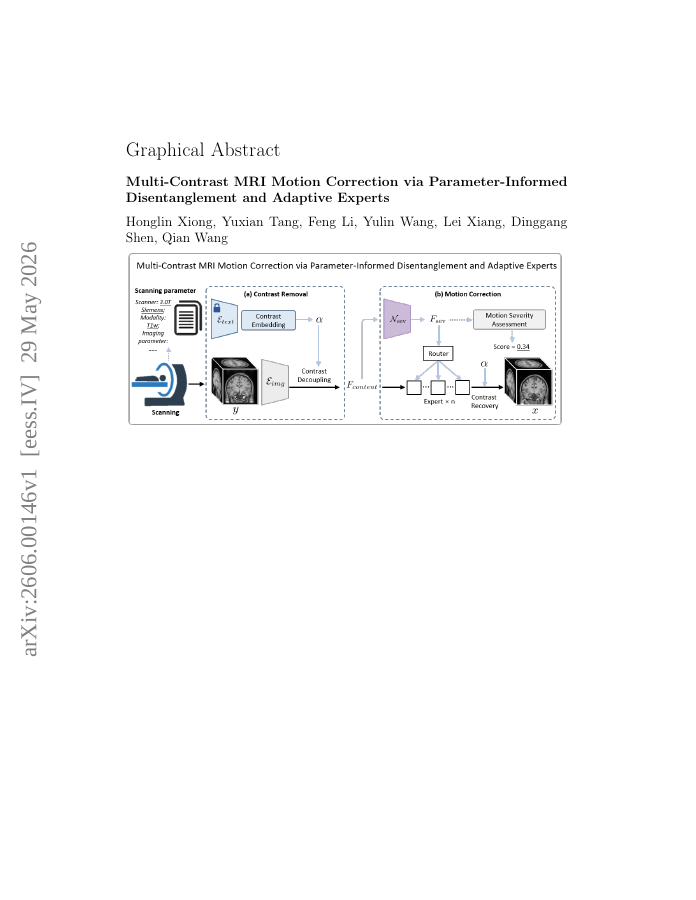
Motion artifacts in magnetic resonance imaging (MRI) degrade diagnostic reliability. Existing deep learning methods are typically contrast-specific and fail to generalize across diverse modalities and artifact severities. We propose a unified framework combining parameter-informed contrast disentanglement with severity-aware adaptive correction. ScanCLIP, pretrained on over 30,000 MRI text-image pairs, derives contrast embeddings from acquisition parameters to disentangle contrast style from anatomical content, yielding contrast-free features. A Vision Transformer then estimates motion severity and routes features through a Mixture-of-Experts network, enabling targeted artifact correction. A dual-pathway decoder reconstructs both the clean image and residual artifact map, enforcing image-space consistency. On IXI and HCP benchmarks, our method improves PSNR by 0.75 dB and SSIM by up to 0.0279 over state-of-the-art approaches, with larger gains at higher artifact severities. It further demonstrates robust zero-shot generalization on real-world clinical data acquired with unseen scanning parameters, where existing methods either fail to remove artifacts or introduce additional distortions.
Multi-Contrast MRI Motion Correction via Parameter-Informed Disentanglement and Adaptive Experts
Motion artifacts in magnetic resonance imaging (MRI) degrade diagnostic reliability. Existing deep learning methods are typically contrast-specific and fail to generalize across diverse modalities and artifact severities.
- Preview
- Year
- 2026
- Hosting
- Excerpt onlyCC-BY-NC-SA-4.0
Cite
Notes
Only stored in your browser.
Attribution
- Abstract & full text
- arxiv.org/abs/2606.00146CC-BY-NC-SA-4.0
- TL;DR
- Semantic Scholar