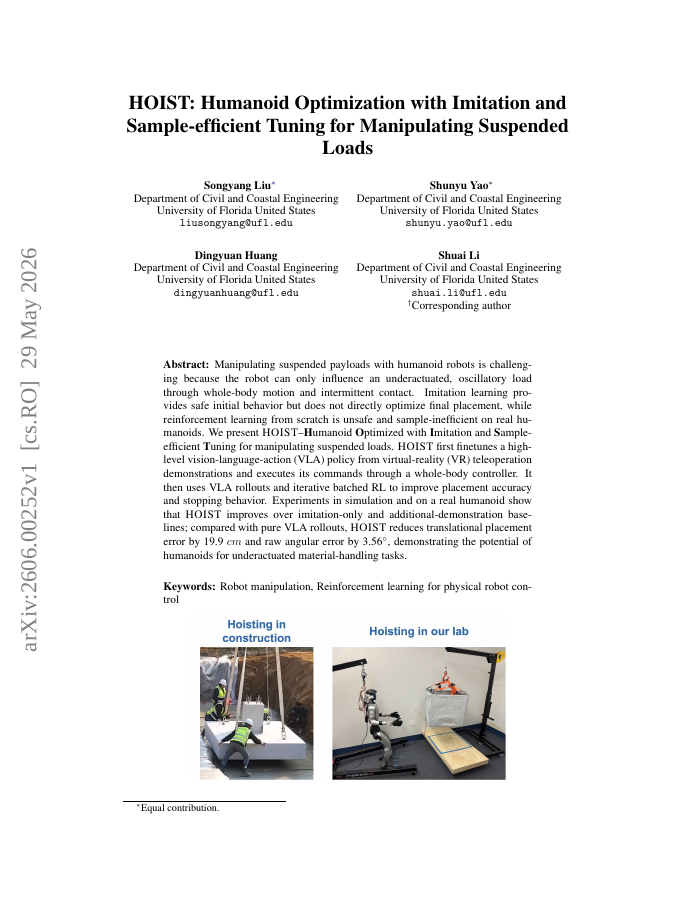
Manipulating suspended payloads with humanoid robots is challenging because the robot can only influence an underactuated, oscillatory load through whole-body motion and intermittent contact. Imitation learning provides safe initial behavior but does not directly optimize final placement, while reinforcement learning from scratch is unsafe and sample-inefficient on real humanoids. We present HOIST-Humanoid Optimized with Imitation and Sample-efficient Tuning for manipulating suspended loads. HOIST first finetunes a high-level vision-language-action (VLA) policy from virtual-reality (VR) teleoperation demonstrations and executes its commands through a whole-body controller. It then uses VLA rollouts and iterative batched RL to improve placement accuracy and stopping behavior. Experiments in simulation and on a real humanoid show that HOIST improves over imitation-only and additional-demonstration baselines; compared with pure VLA rollouts, HOIST reduces translational placement error by 19.9 cm and raw angular error by 3.56 degrees, demonstrating the potential of humanoids for underactuated material-handling tasks.
HOIST: Humanoid Optimization with Imitation and Sample-efficient Tuning for Manipulating Suspended Loads
Manipulating suspended payloads with humanoid robots is challenging because the robot can only influence an underactuated, oscillatory load through whole-body motion and intermittent contact.
- Preview
- Year
- 2026
- Hosting
- Full text hostedCC-BY-4.0
Cite
Notes
Only stored in your browser.
Attribution
- Abstract & full text
- arxiv.org/abs/2606.00252CC-BY-4.0
- TL;DR
- Semantic Scholar