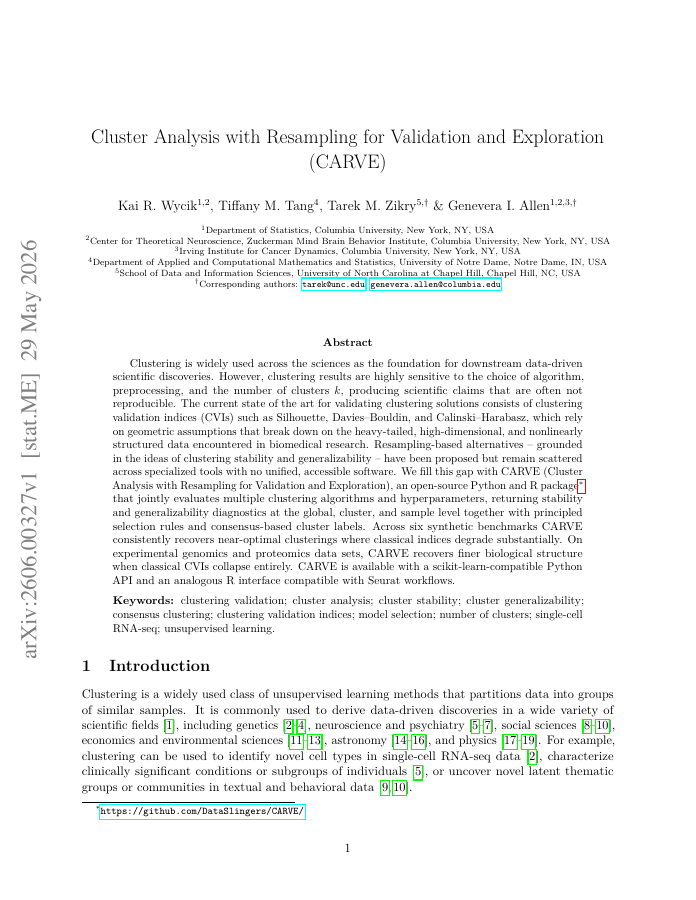
Clustering is widely used across the sciences as the foundation for downstream data-driven scientific discoveries. However, clustering results are highly sensitive to the choice of algorithm, preprocessing, and the number of clusters $k$, producing scientific claims that are often not reproducible. The current state of the art for validating clustering solutions consists of clustering validation indices (CVIs) such as Silhouette, Davies-Bouldin, and Calinski-Harabasz, which rely on geometric assumptions that break down on the heavy-tailed, high-dimensional, and nonlinearly structured data encountered in biomedical research. Resampling-based alternatives - grounded in the ideas of clustering stability and generalizability - have been proposed but remain scattered across specialized tools with no unified, accessible software. We fill this gap with CARVE (Cluster Analysis with Resampling for Validation and Exploration), an open-source Python and R package that jointly evaluates multiple clustering algorithms and hyperparameters, returning stability and generalizability diagnostics at the global, cluster, and sample level together with principled selection rules and consensus-based cluster labels. Across six synthetic benchmarks CARVE consistently recovers near-optimal clusterings where classical indices degrade substantially. On experimental genomics and proteomics data sets, CARVE recovers finer biological structure when classical CVIs collapse entirely. CARVE is available with a scikit-learn-compatible Python API and an analogous R interface compatible with Seurat workflows.
Cluster Analysis with Resampling for Validation and Exploration (CARVE)
Clustering is widely used across the sciences as the foundation for downstream data-driven scientific discoveries. However, clustering results are highly sensitive to the choice of algorithm, preprocessing, and the number of clusters $k$, producing scientific claims that are…
- Preview
- Year
- 2026
- Hosting
- Full text hostedCC-BY-4.0
Cite
Notes
Only stored in your browser.
Attribution
- Abstract & full text
- arxiv.org/abs/2606.00327CC-BY-4.0
- TL;DR
- Semantic Scholar