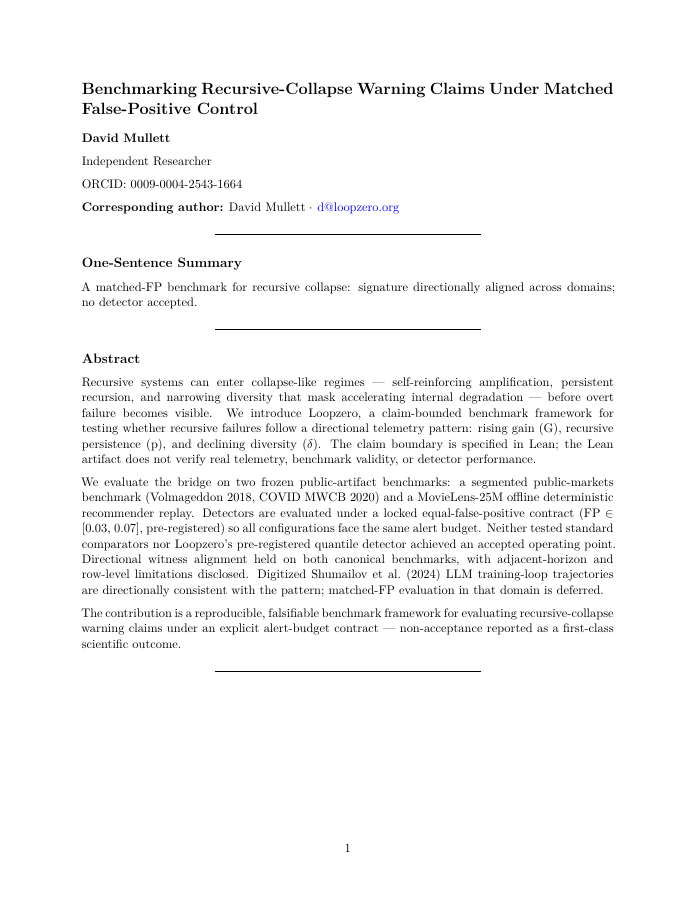
Recursive systems can enter collapse-like regimes -- self-reinforcing amplification, persistent recursion, and narrowing diversity that mask accelerating internal degradation -- before overt failure becomes visible. We introduce Loopzero, a claim-bounded benchmark framework for testing whether recursive failures follow a directional telemetry pattern: rising gain (G), recursive persistence (p), and declining diversity ($δ$). The claim boundary is specified in Lean; the Lean artifact does not verify real telemetry, benchmark validity, or detector performance. We evaluate the bridge on two frozen public-artifact benchmarks: a segmented public-markets benchmark (Volmageddon 2018, COVID MWCB 2020) and a MovieLens-25M offline deterministic recommender replay. Detectors are evaluated under a locked equal-false-positive contract (FP $\in$ [0.03, 0.07], pre-registered) so all configurations face the same alert budget. Neither tested standard comparators nor Loopzero's pre-registered quantile detector achieved an accepted operating point. Directional witness alignment held on both canonical benchmarks, with adjacent-horizon and row-level limitations disclosed. Digitized Shumailov et al. (2024) LLM training-loop trajectories are directionally consistent with the pattern; matched-FP evaluation in that domain is deferred. The contribution is a reproducible, falsifiable benchmark framework for evaluating recursive-collapse warning claims under an explicit alert-budget contract -- non-acceptance reported as a first-class scientific outcome.
Benchmarking Recursive-Collapse Warning Claims Under Matched False-Positive Control
Recursive systems can enter collapse-like regimes -- self-reinforcing amplification, persistent recursion, and narrowing diversity that mask accelerating internal degradation -- before overt failure becomes visible.
- Preview
- Year
- 2026
- Hosting
- Full text hostedCC-BY-4.0
Cite
Notes
Only stored in your browser.
Attribution
- Abstract & full text
- arxiv.org/abs/2606.00329CC-BY-4.0
- TL;DR
- Semantic Scholar