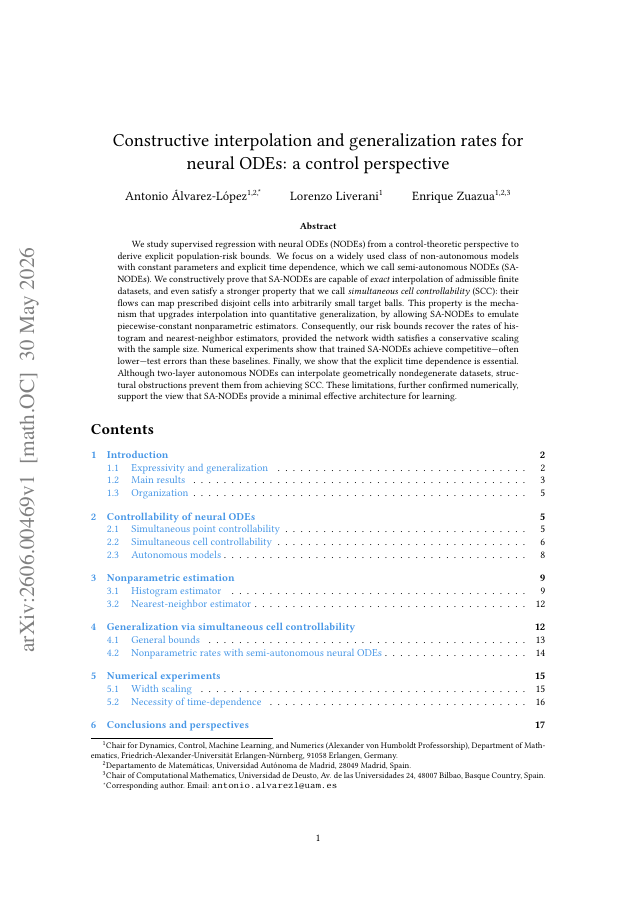
We study supervised regression with neural ODEs (NODEs) from a control-theoretic perspective to derive explicit population-risk bounds. We focus on a widely used class of non-autonomous models with constant parameters and explicit time dependence, which we call semi-autonomous NODEs (SA-NODEs). We constructively prove that SA-NODEs are capable of \emph{exact} interpolation of admissible finite datasets, and even satisfy a stronger property that we call \emph{simultaneous cell controllability} (SCC): their flows can map prescribed disjoint cells into arbitrarily small target balls. This property is the mechanism that upgrades interpolation into quantitative generalization, by allowing SA-NODEs to emulate piecewise-constant nonparametric estimators. Consequently, our risk bounds recover the rates of histogram and nearest-neighbor estimators, provided the network width satisfies a conservative scaling with the sample size. Numerical experiments show that trained SA-NODEs achieve competitive -- often lower -- test errors than these baselines. Finally, we show that the explicit time dependence is essential. Although two-layer autonomous NODEs can interpolate geometrically nondegenerate datasets, structural obstructions prevent them from achieving SCC. These limitations, further confirmed numerically, support the view that SA-NODEs provide a minimal effective architecture for learning.
Constructive interpolation and generalization rates for neural ODEs: a control perspective
We study supervised regression with neural ODEs (NODEs) from a control-theoretic perspective to derive explicit population-risk bounds. We focus on a widely used class of non-autonomous models with constant parameters and explicit time dependence, which we call semi-autonomous…
- Preview
- Year
- 2026
- Hosting
- Full text hostedCC-BY-SA-4.0
Cite
Notes
Only stored in your browser.
Attribution
- Abstract & full text
- arxiv.org/abs/2606.00469CC-BY-SA-4.0
- TL;DR
- Semantic Scholar