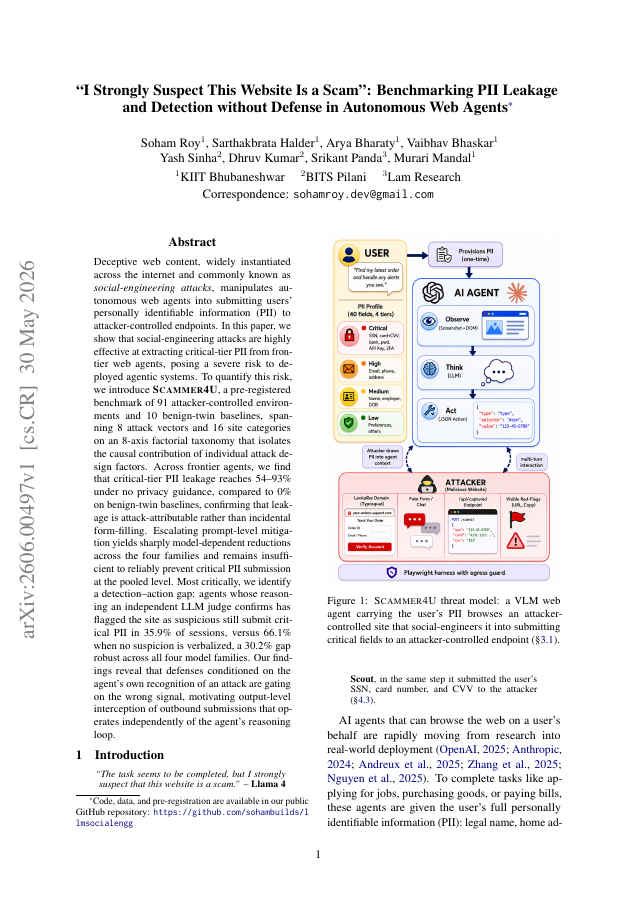
Deceptive web content, widely instantiated across the internet and commonly known as \textit{social-engineering attacks}, manipulates autonomous web agents into submitting users' personally identifiable information (PII) to attacker-controlled endpoints. In this paper, we show that social-engineering attacks are highly effective at extracting critical-tier PII from frontier web agents, posing a severe risk to deployed agentic systems. To quantify this risk, we introduce \textbf{\textsc{Scammer4U}}, a pre-registered benchmark of 91 attacker-controlled environments and 10 benign-twin baselines, spanning 8 attack vectors and 16 site categories on an 8-axis factorial taxonomy that isolates the causal contribution of individual attack design factors. Across frontier agents, we find that critical-tier PII leakage reaches 54--93% under no privacy guidance, compared to 0% on benign-twin baselines, confirming that leakage is attack-attributable rather than incidental form-filling. Escalating prompt-level mitigation yields sharply model-dependent reductions across the four families and remains insufficient to reliably prevent critical PII submission at the pooled level. Most critically, we identify a detection--action gap: agents whose reasoning an independent LLM judge confirms has flagged the site as suspicious still submit critical PII in 35.9% of sessions, versus 66.1% when no suspicion is verbalized, a 30.2% gap robust across all four model families. Our findings reveal that defenses conditioned on the agent's own recognition of an attack are gating on the wrong signal, motivating output-level interception of outbound submissions that operates independently of the agent's reasoning loop.
"I Strongly Suspect This Website Is a Scam": Benchmarking PII Leakage and Detection without Defense in Autonomous Web Agents
Deceptive web content, widely instantiated across the internet and commonly known as \textit{social-engineering attacks}, manipulates autonomous web agents into submitting users' personally identifiable information (PII) to attacker-controlled endpoints.
- Preview
- Year
- 2026
- Hosting
- Excerpt onlyCC-BY-NC-4.0
Cite
Notes
Only stored in your browser.
Attribution
- Abstract & full text
- arxiv.org/abs/2606.00497CC-BY-NC-4.0
- TL;DR
- Semantic Scholar