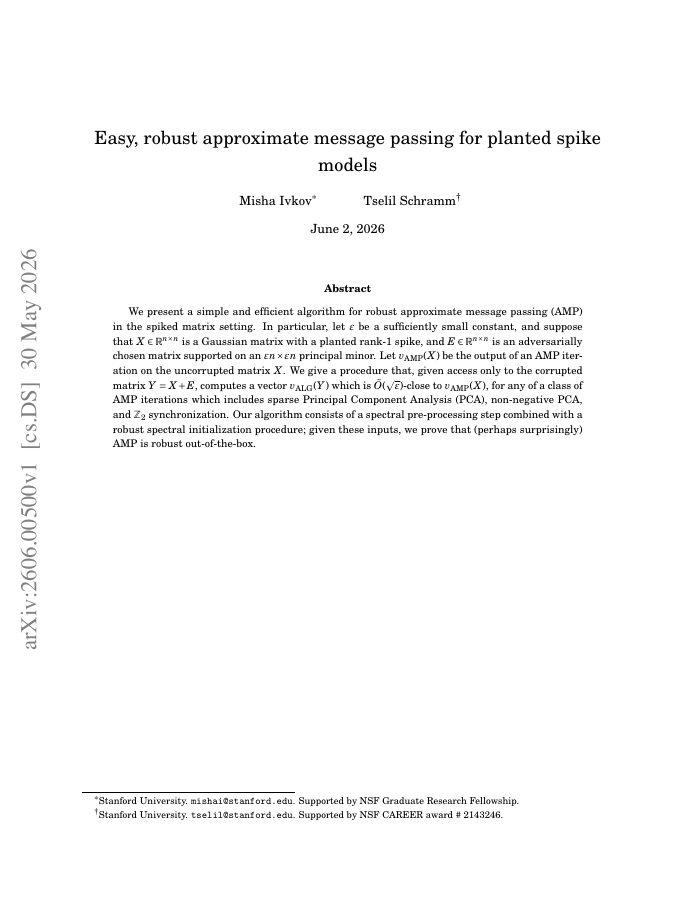
We present a simple and efficient algorithm for robust approximate message passing (AMP) in the spiked matrix setting. In particular, let $\varepsilon$ be a sufficiently small constant, and suppose that $X \in \mathbb R^{n \times n}$ is a Gaussian matrix with a planted rank-$1$ spike, and $E \in \mathbb R^{n \times n}$ is an adversarially chosen matrix supported on an $\varepsilon n \times \varepsilon n$ principal minor. Let $v_{\mathrm{AMP}}(X)$ be the output of an AMP iteration on the uncorrupted matrix $X$. We give a procedure that, given access only to the corrupted matrix $Y = X + E$, computes a vector $v_{\mathrm{ALG}}(Y)$ which is $\tilde{O}(\sqrt{\varepsilon})$-close to $v_{\mathrm{AMP}}(X)$, for any of a class of AMP iterations which includes sparse Principal Component Analysis (PCA), non-negative PCA, and $\mathbb Z_2$ synchronization. Our algorithm consists of a spectral pre-processing step combined with a robust spectral initialization procedure; given these inputs, we prove that (perhaps surprisingly) AMP is robust out-of-the-box.
Easy, robust approximate message passing for planted spike models
We present a simple and efficient algorithm for robust approximate message passing (AMP) in the spiked matrix setting. In particular, let $\varepsilon$ be a sufficiently small constant, and suppose that $X \in \mathbb R^{n \times n}$ is a Gaussian matrix with a planted rank-$1$…
- Preview
- Year
- 2026
- Hosting
- Abstract onlyARXIV-DEFAULT
Cite
Notes
Only stored in your browser.
Attribution
- Abstract & full text
- arxiv.org/abs/2606.00500ARXIV-DEFAULT
- TL;DR
- Semantic Scholar