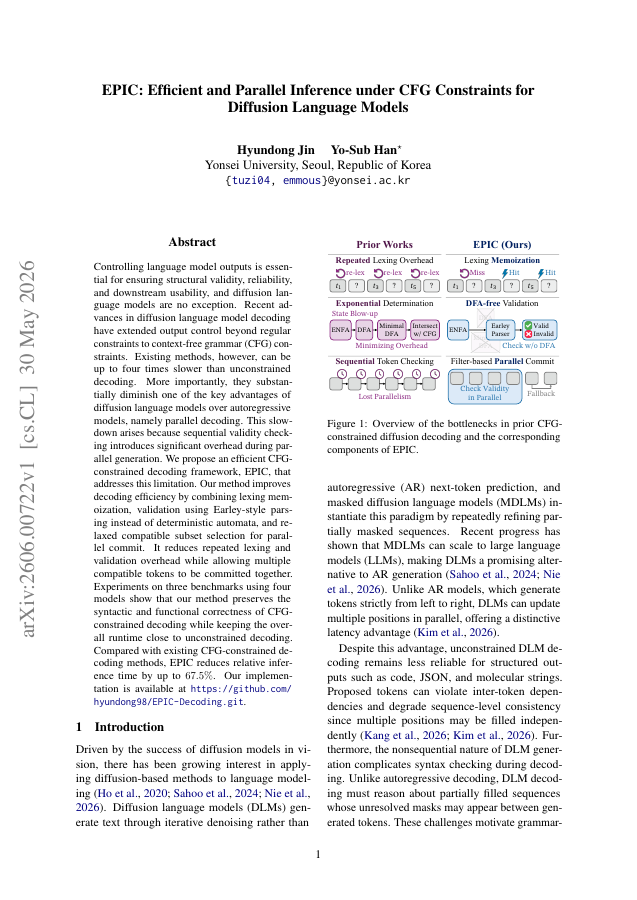
Controlling language model outputs is essential for ensuring structural validity, reliability, and downstream usability, and diffusion language models are no exception. Recent advances in diffusion language model decoding have extended output control beyond regular constraints to context-free grammar (CFG) constraints. Existing methods, however, can be up to four times slower than unconstrained decoding. More importantly, they substantially diminish one of the key advantages of diffusion language models over autoregressive models, namely parallel decoding. This slowdown arises because sequential validity checking introduces significant overhead during parallel generation. We propose an efficient CFG-constrained decoding framework, EPIC, that addresses this limitation. Our method improves decoding efficiency by combining lexing memoization, validation using Earley-style parsing instead of deterministic automata, and relaxed compatible subset selection for parallel commit. It reduces repeated lexing and validation overhead while allowing multiple compatible tokens to be committed together. Experiments on three benchmarks using four models show that our method reduces inference time by up to 67.5% and decreases the additional overhead by up to 90.5% compared with existing CFG-constrained decoding methods. Our implementation is available at https://github.com/hyundong98/EPIC-Decoding.git .
EPIC: Efficient and Parallel Inference under CFG Constraints for Diffusion Language Models
Controlling language model outputs is essential for ensuring structural validity, reliability, and downstream usability, and diffusion language models are no exception. Recent advances in diffusion language model decoding have extended output control beyond regular constraints…
- Preview
- Year
- 2026
- Hosting
- Excerpt onlyCC-BY-NC-4.0
Cite
Notes
Only stored in your browser.
Attribution
- Abstract & full text
- arxiv.org/abs/2606.00722CC-BY-NC-4.0
- TL;DR
- Semantic Scholar