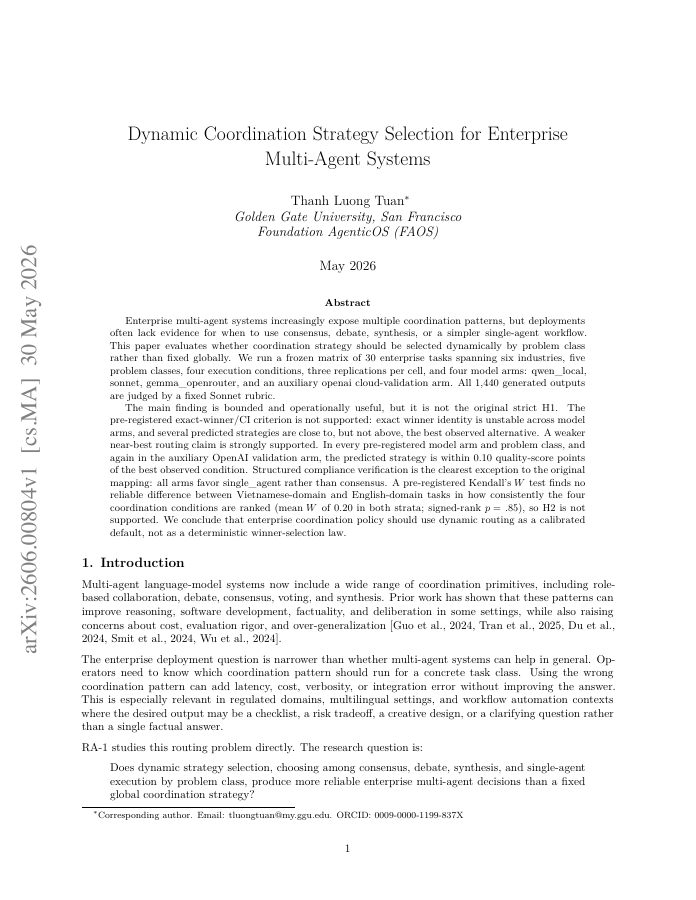
Enterprise multi-agent systems increasingly expose multiple coordination patterns, but deployments often lack evidence for when to use consensus, debate, synthesis, or a simpler single-agent workflow. This paper evaluates whether coordination strategy should be selected dynamically by problem class rather than fixed globally. We run a frozen matrix of 30 enterprise tasks spanning six industries, five problem classes, four execution conditions, three replications per cell, and four model arms: qwen_local, sonnet, gemma_openrouter, and an auxiliary openai cloud-validation arm. All 1,440 generated outputs are judged by a fixed Sonnet rubric. The main finding is bounded and operationally useful, but it is not the original strict H1. The pre-registered exact-winner/CI criterion is not supported: exact winner identity is unstable across model arms, and several predicted strategies are close to, but not above, the best observed alternative. A weaker near-best routing claim is strongly supported. In every pre-registered model arm and problem class, and again in the auxiliary OpenAI validation arm, the predicted strategy is within 0.10 quality-score points of the best observed condition. Structured compliance verification is the clearest exception to the original mapping: all arms favor single_agent rather than consensus. A pre-registered Kendall's W test finds no reliable difference between Vietnamese-domain and English-domain tasks in how consistently the four coordination conditions are ranked (mean W of 0.20 in both strata; signed-rank p = .85), so H2 is not supported. We conclude that enterprise coordination policy should use dynamic routing as a calibrated default, not as a deterministic winner-selection law.
Dynamic Coordination Strategy Selection for Enterprise Multi-Agent Systems
Enterprise multi-agent systems increasingly expose multiple coordination patterns, but deployments often lack evidence for when to use consensus, debate, synthesis, or a simpler single-agent workflow.
- Preview
- Year
- 2026
- Hosting
- Full text hostedCC-BY-4.0
Cite
Notes
Only stored in your browser.
Attribution
- Abstract & full text
- arxiv.org/abs/2606.00804CC-BY-4.0
- TL;DR
- Semantic Scholar