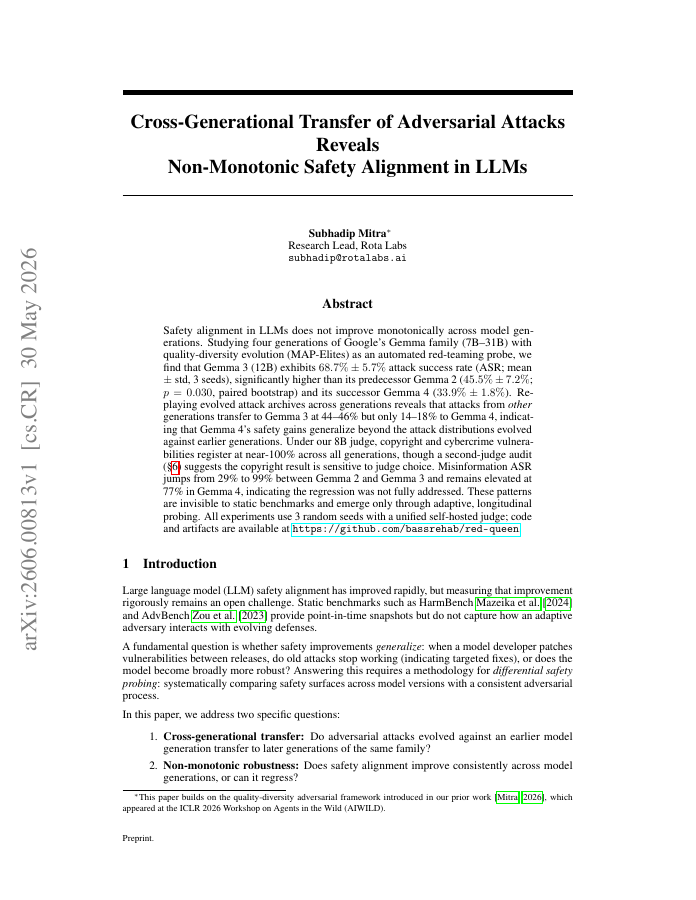
Safety alignment in LLMs does not improve monotonically across model generations. Studying four generations of Google's Gemma family (7B-31B) with quality-diversity evolution (MAP-Elites) as an automated red-teaming probe, we find that Gemma 3 (12B) exhibits 68.7% +/- 5.7% attack success rate (ASR; mean +/- std, 3 seeds), significantly higher than its predecessor Gemma 2 (45.5% +/- 7.2%; p = 0.030, paired bootstrap) and its successor Gemma 4 (33.9% +/- 1.8%). Replaying evolved attack archives across generations reveals that attacks from other generations transfer to Gemma 3 at 44-46% but only 14-18% to Gemma 4, indicating that Gemma 4's safety gains generalize beyond the attack distributions evolved against earlier generations. Under our 8B judge, copyright and cybercrime vulnerabilities register at near-100% across all generations, though a second-judge audit (Section 6) suggests the copyright result is sensitive to judge choice. Misinformation ASR jumps from 29% to 99% between Gemma 2 and Gemma 3 and remains elevated at 77% in Gemma 4, indicating the regression was not fully addressed. These patterns are invisible to static benchmarks and emerge only through adaptive, longitudinal probing. All experiments use 3 random seeds with a unified self-hosted judge; code and artifacts are available at https://github.com/bassrehab/red-queen.
Cross-Generational Transfer of Adversarial Attacks Reveals Non-Monotonic Safety Alignment in LLMs
Safety alignment in LLMs does not improve monotonically across model generations. Studying four generations of Google's Gemma family (7B-31B) with quality-diversity evolution (MAP-Elites) as an automated red-teaming probe, we find that Gemma 3 (12B) exhibits 68.7% +/- 5.7%…
- Preview
- Year
- 2026
- Hosting
- Abstract onlyARXIV-DEFAULT
Cite
Notes
Only stored in your browser.
Attribution
- Abstract & full text
- arxiv.org/abs/2606.00813ARXIV-DEFAULT
- TL;DR
- Semantic Scholar