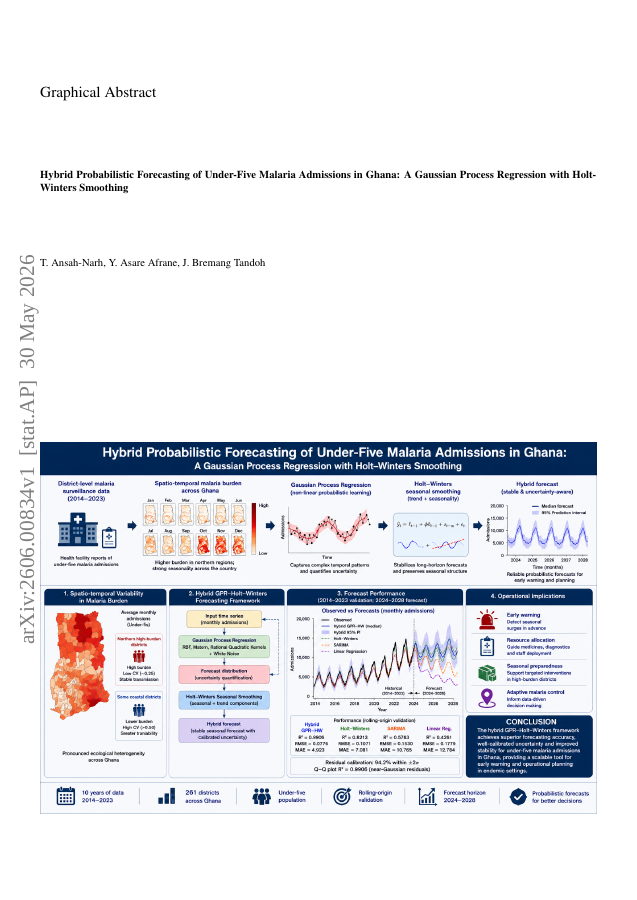
Accurate malaria forecasting remains a major challenge in sub-Saharan Africa, where strong seasonality, reporting uncertainty, and non-stationary transmission dynamics reduce the reliability of conventional models. In Ghana, district-level malaria surveillance requires forecasting frameworks that are probabilistically rigorous and robust under limited data. This study proposes a hybrid framework integrating Gaussian Process Regression (GPR) with Holt-Winters exponential smoothing for modelling monthly under-five malaria admissions. GPR captures non-linear behaviour and predictive uncertainty, while Holt-Winters stabilises long-horizon forecasts and preserves seasonal structure. Using ten years of district-level data (2014-2023), performance was evaluated via rolling-origin expanding-window validation. The hybrid model achieved R^2 = 0.9906 versus 0.8213 for Holt-Winters alone, with 94.2% of residuals within \pm 2σ bounds. Forecasts for 2024-2028 project average monthly admissions from approximately 8{,}000 to 12{,}200 cases. Spatio-temporal analysis revealed pronounced ecological heterogeneity: northern high-burden districts exhibited stable relative patterns despite large absolute fluctuations. The framework provides a scalable probabilistic approach for malaria early warning and operational planning in endemic settings, supporting Ghana's national malaria control strategy.
Hybrid Probabilistic Forecasting of Under-Five Malaria Admissions in Ghana: A Gaussian Process Regression with Holt-Winters Smoothing
Accurate malaria forecasting remains a major challenge in sub-Saharan Africa, where strong seasonality, reporting uncertainty, and non-stationary transmission dynamics reduce the reliability of conventional models.
- Preview
- Year
- 2026
- Hosting
- Full text hostedCC-BY-4.0
Cite
Notes
Only stored in your browser.
Attribution
- Abstract & full text
- arxiv.org/abs/2606.00834CC-BY-4.0
- TL;DR
- Semantic Scholar