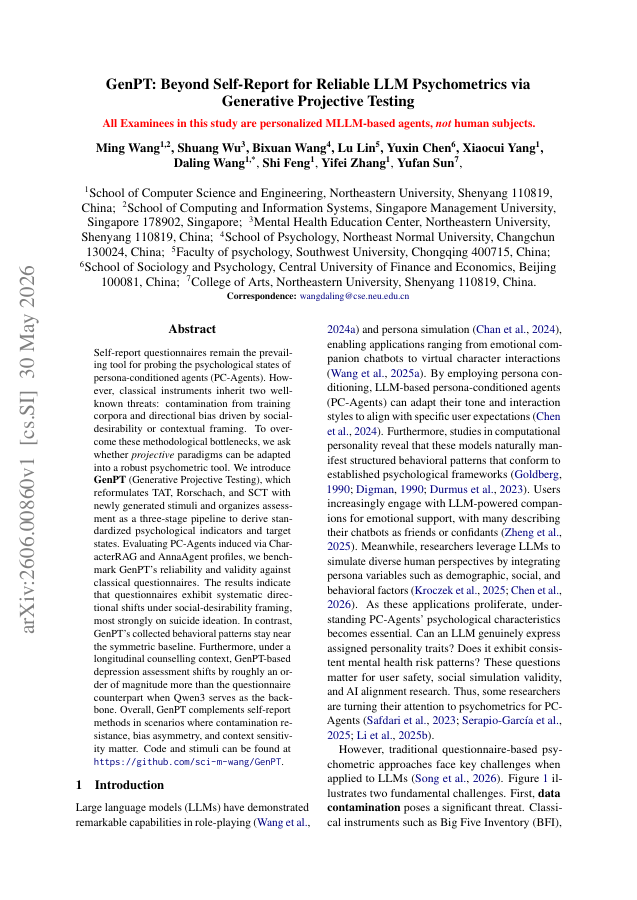
Self-report questionnaires remain the prevailing tool for probing the psychological states of persona-conditioned agents (PC-Agents). However, classical instruments inherit two well-known threats: contamination from training corpora and directional bias driven by social-desirability or contextual framing. To overcome these methodological bottlenecks, we ask whether projective paradigms can be adapted into a robust psychometric tool. We introduce \textbf{GenPT} (Generative Projective Testing), which reformulates TAT, Rorschach, and SCT with newly generated stimuli and organizes assessment as a three-stage pipeline to derive standardized psychological indicators and target states. Evaluating PC-Agents induced via CharacterRAG and AnnaAgent profiles, we benchmark GenPT's reliability and validity against classical questionnaires. The results indicate that questionnaires exhibit systematic directional shifts under social-desirability framing, most strongly on suicide ideation. In contrast, GenPT's collected behavioral patterns stay near the symmetric baseline. Furthermore, under a longitudinal counselling context, GenPT-based depression assessment shifts by roughly an order of magnitude more than the questionnaire counterpart when Qwen3 serves as the backbone. Overall, GenPT complements self-report methods in scenarios where contamination resistance, bias asymmetry, and context sensitivity matter. Code and stimuli can be found at https://github.com/sci-m-wang/GenPT.
GenPT: Beyond Self-Report for Reliable LLM Psychometrics via Generative Projective Testing
Self-report questionnaires remain the prevailing tool for probing the psychological states of persona-conditioned agents (PC-Agents). However, classical instruments inherit two well-known threats: contamination from training corpora and directional bias driven by…
- Preview
- Year
- 2026
- Hosting
- Abstract onlyARXIV-DEFAULT
Cite
Notes
Only stored in your browser.
Attribution
- Abstract & full text
- arxiv.org/abs/2606.00860ARXIV-DEFAULT
- TL;DR
- Semantic Scholar