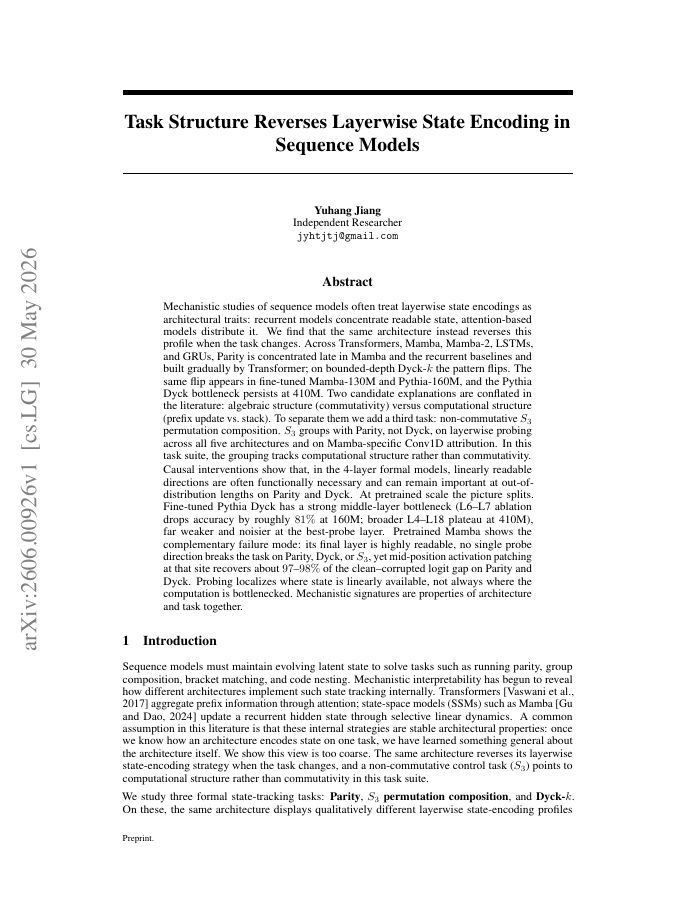
Mechanistic studies of sequence models often treat layerwise state encodings as architectural traits: recurrent models concentrate readable state, attention-based models distribute it. We find that the same architecture reverses this profile when the task changes. Across Transformers, Mamba, Mamba-2, LSTMs, and GRUs, Parity is concentrated late in Mamba and the recurrent baselines and built gradually by Transformer; on bounded-depth Dyck-k the pattern flips. The same flip appears in fine-tuned Mamba-130M and Pythia-160M, and the Pythia Dyck bottleneck persists at 410M. Two explanations are conflated in the literature: algebraic structure (commutativity) versus computational structure (prefix update vs. stack). To separate them we add a third task: non-commutative S_3 permutation composition. S_3 groups with Parity, not Dyck, on layerwise probing across all five architectures and on Mamba-specific Conv1D attribution, so the grouping tracks computational structure rather than commutativity. Causal interventions show that, in the 4-layer formal models, linearly readable directions are often functionally necessary and can remain important at out-of-distribution lengths on Parity and Dyck. At pretrained scale the picture splits. Fine-tuned Pythia Dyck has a strong middle-layer bottleneck (L6-L7 ablation drops accuracy by roughly 81% at 160M; broader L4-L18 plateau at 410M), far weaker at the best-probe layer. Pretrained Mamba shows the complementary failure mode: its final layer is highly readable, no single probe direction breaks the task on Parity, Dyck, or S_3, yet mid-position activation patching there recovers about 97-98% of the clean-corrupted logit gap. Probing localizes where state is linearly available, not always where the computation is bottlenecked. Mechanistic signatures are properties of architecture and task together.
Task Structure Reverses Layerwise State Encoding in Sequence Models
Mechanistic studies of sequence models often treat layerwise state encodings as architectural traits: recurrent models concentrate readable state, attention-based models distribute it. We find that the same architecture reverses this profile when the task changes.
- Preview
- Year
- 2026
- Hosting
- Full text hostedCC-BY-4.0
Cite
Notes
Only stored in your browser.
Attribution
- Abstract & full text
- arxiv.org/abs/2606.00926CC-BY-4.0
- TL;DR
- Semantic Scholar