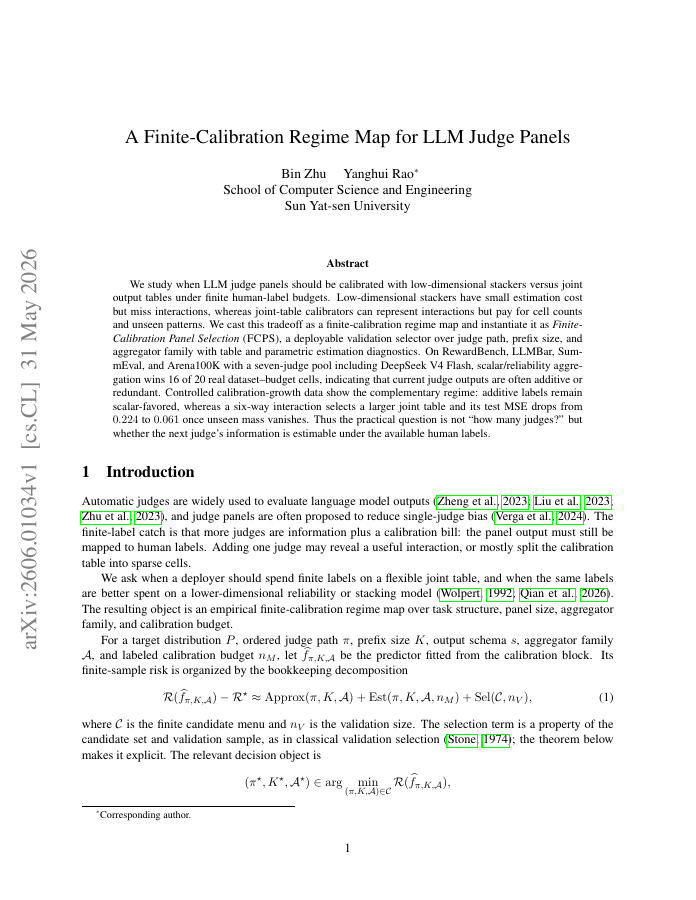
We study when LLM judge panels should be calibrated with low-dimensional stackers versus joint output tables under finite human-label budgets. Low-dimensional stackers have small estimation cost but miss interactions, whereas joint-table calibrators can represent interactions but pay for cell counts and unseen patterns. We cast this tradeoff as a finite-calibration regime map and instantiate it as Finite-Calibration Panel Selection, a deployable validation selector over judge path, prefix size, and aggregator family with table and parametric estimation diagnostics. On RewardBench, LLMBar, SummEval, and Arena100K with a seven-judge pool including DeepSeek V4 Flash, scalar/reliability aggregation wins 16 of 20 real dataset--budget cells, indicating that current judge outputs are often additive or redundant. Controlled calibration-growth data show the complementary regime: additive labels remain scalar-favored, whereas a six-way interaction selects a larger joint table and its test MSE drops from 0.224 to 0.061 once unseen mass vanishes. Thus the practical question is not ``how many judges?'' but whether the next judge's information is estimable under the available human labels.
A Finite-Calibration Regime Map for LLM Judge Panels
We study when LLM judge panels should be calibrated with low-dimensional stackers versus joint output tables under finite human-label budgets. Low-dimensional stackers have small estimation cost but miss interactions, whereas joint-table calibrators can represent interactions…
- Preview
- Year
- 2026
- Hosting
- Full text hostedCC-BY-4.0
Cite
Notes
Only stored in your browser.
Attribution
- Abstract & full text
- arxiv.org/abs/2606.01034CC-BY-4.0
- TL;DR
- Semantic Scholar