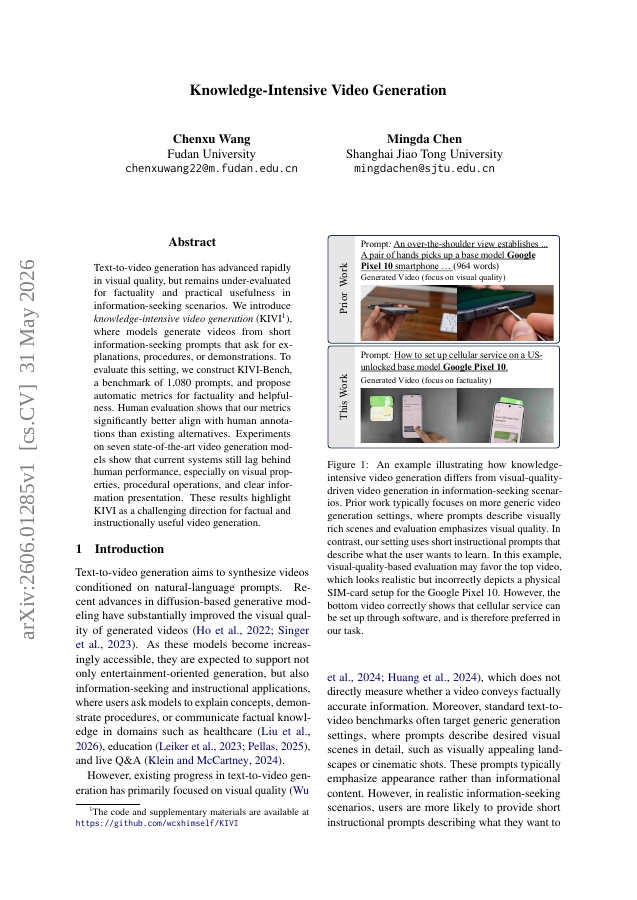
Text-to-video generation has advanced rapidly in visual quality, but remains under-evaluated for factuality and practical usefulness. We introduce knowledge-intensive video generation (KIVI), where models generate videos from short information-seeking prompts that ask for explanations, procedures, or demonstrations. To evaluate this setting, we construct KIVI-Bench, a benchmark of 1,080 prompts, and propose automatic metrics for factuality and helpfulness. Human evaluation shows that our metrics significantly better align with human annotations than existing alternatives. Experiments on seven state-of-the-art video generation models show that current systems still lag behind human performance, especially on visual properties, procedural operations, and clear information presentation. These results highlight KIVI as a challenging direction for factual and instructionally useful video generation.
Knowledge-Intensive Video Generation
Text-to-video generation has advanced rapidly in visual quality, but remains under-evaluated for factuality and practical usefulness. We introduce knowledge-intensive video generation (KIVI), where models generate videos from short information-seeking prompts that ask for…
- Preview
- Year
- 2026
- Hosting
- Abstract onlyARXIV-DEFAULT
Cite
Notes
Only stored in your browser.
Attribution
- Abstract & full text
- arxiv.org/abs/2606.01285ARXIV-DEFAULT
- TL;DR
- Semantic Scholar