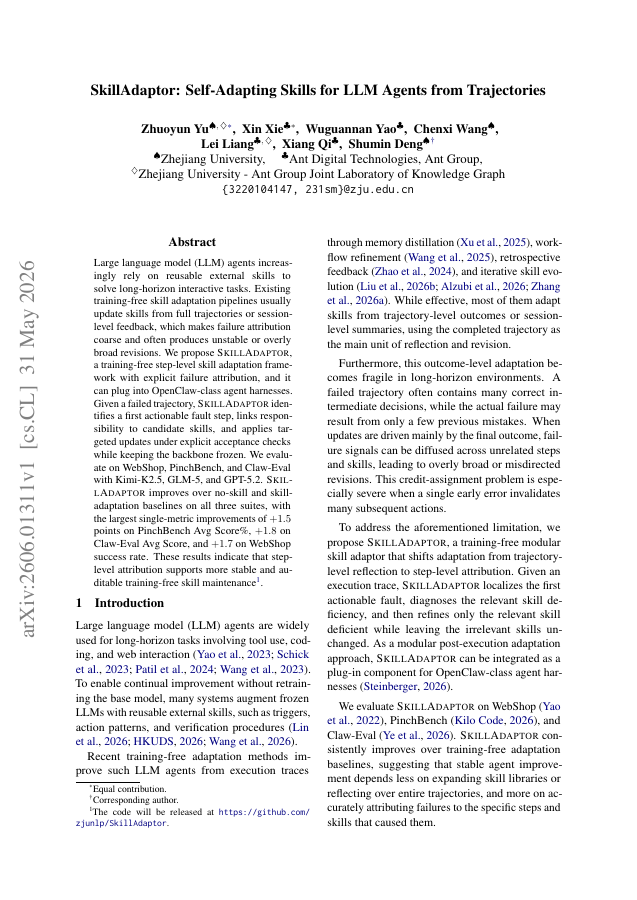
Large language model (LLM) agents increasingly rely on reusable external skills to solve long-horizon interactive tasks. Existing training-free skill adaptation pipelines usually update skills from full trajectories or session-level feedback, which makes failure attribution coarse and often produces unstable or overly broad revisions. We propose SkillAdaptor, a training-free step-level skill adaptation framework with explicit failure attribution, and it can plug into OpenClaw-class agent harnesses. Given a failed trajectory, SkillAdaptor identifies a first actionable fault step, links responsibility to candidate skills, and applies targeted updates under explicit acceptance checks while keeping the backbone frozen. We evaluate on WebShop, PinchBench, and Claw-Eval with Kimi-K2.5, GLM-5, and GPT-5.2. SkillAdaptor improves over no-skill and skill-adaptation baselines on all three suites, with the largest single-metric improvements of +1.5 points on PinchBench Avg Score%, +1.8 on Claw-Eval Avg Score, and +1.7 on WebShop success rate. These results indicate that step-level attribution supports more stable and auditable training-free skill maintenance\footnote{The code will be released at https://github.com/zjunlp/SkillAdaptor.}.
SkillAdaptor: Self-Adapting Skills for LLM Agents from Trajectories
Large language model (LLM) agents increasingly rely on reusable external skills to solve long-horizon interactive tasks. Existing training-free skill adaptation pipelines usually update skills from full trajectories or session-level feedback, which makes failure attribution…
- Preview
- Year
- 2026
- Hosting
- Excerpt onlyCC-BY-NC-SA-4.0
Cite
Notes
Only stored in your browser.
Attribution
- Abstract & full text
- arxiv.org/abs/2606.01311CC-BY-NC-SA-4.0
- TL;DR
- Semantic Scholar