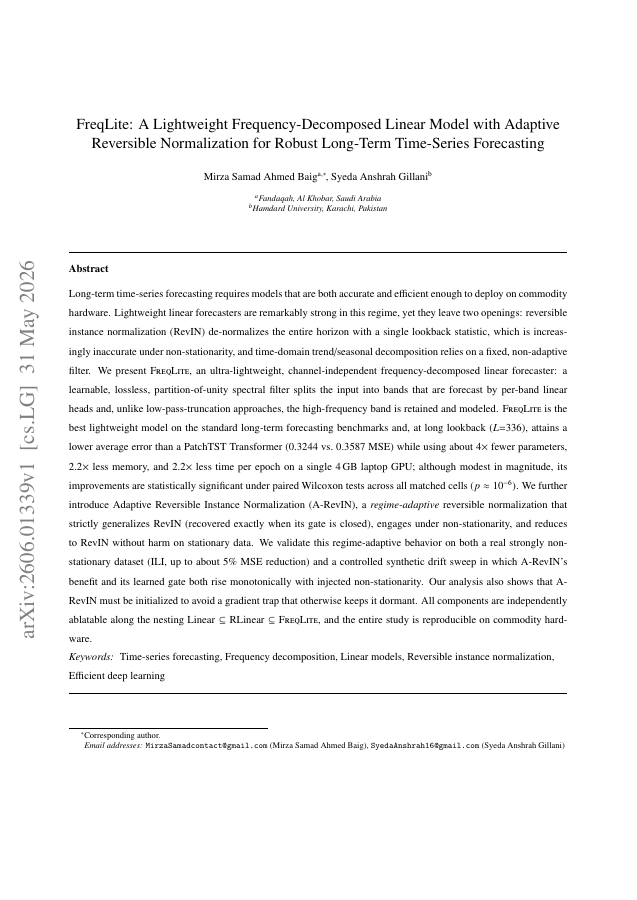
Long-term time-series forecasting needs models that are accurate yet efficient enough for commodity hardware. Lightweight linear forecasters are remarkably strong in this regime, yet they leave two openings: reversible instance normalization (RevIN) de-normalizes the entire horizon with a single lookback statistic, which is inaccurate under non-stationarity, and time-domain trend/seasonal decomposition relies on a fixed, non-adaptive filter. We present FreqLite, an ultra-lightweight, channel-independent frequency-decomposed linear forecaster: a learnable, lossless, partition-of-unity spectral filter splits the input into bands that are forecast by per-band linear heads and, unlike low-pass-truncation approaches, the high-frequency band is retained and modeled. FreqLite is the best lightweight model on the standard long-term forecasting benchmarks and, at long lookback (L=336), attains a lower average error than a PatchTST Transformer (0.3244 vs. 0.3587 MSE) while using 4x fewer parameters, 2.2x less memory, and 2.2x less time per epoch on a single 4 GB laptop GPU; although modest in magnitude, its improvements are statistically significant under paired Wilcoxon tests across all matched cells (p < 1e-5). We further introduce Adaptive Reversible Instance Normalization (A-RevIN), a regime-adaptive reversible normalization that strictly generalizes RevIN (recovered exactly when its gate is closed), engages under non-stationarity, and reduces to RevIN without harm on stationary data. We validate this on both a real strongly non-stationary dataset (ILI, up to ~5% MSE reduction) and a controlled synthetic drift sweep in which A-RevIN's benefit and its learned gate both rise monotonically with injected non-stationarity. Every component is independently ablatable (Linear and RLinear are special cases of FreqLite), and all results are reproducible on commodity hardware.
FreqLite: A Lightweight Frequency-Decomposed Linear Model with Adaptive Reversible Normalization for Robust Long-Term Time-Series Forecasting
Long-term time-series forecasting needs models that are accurate yet efficient enough for commodity hardware. Lightweight linear forecasters are remarkably strong in this regime, yet they leave two openings: reversible instance normalization (RevIN) de-normalizes the entire…
- Preview
- Year
- 2026
- Hosting
- Abstract onlyARXIV-DEFAULT
Cite
Notes
Only stored in your browser.
Attribution
- Abstract & full text
- arxiv.org/abs/2606.01339ARXIV-DEFAULT
- TL;DR
- Semantic Scholar