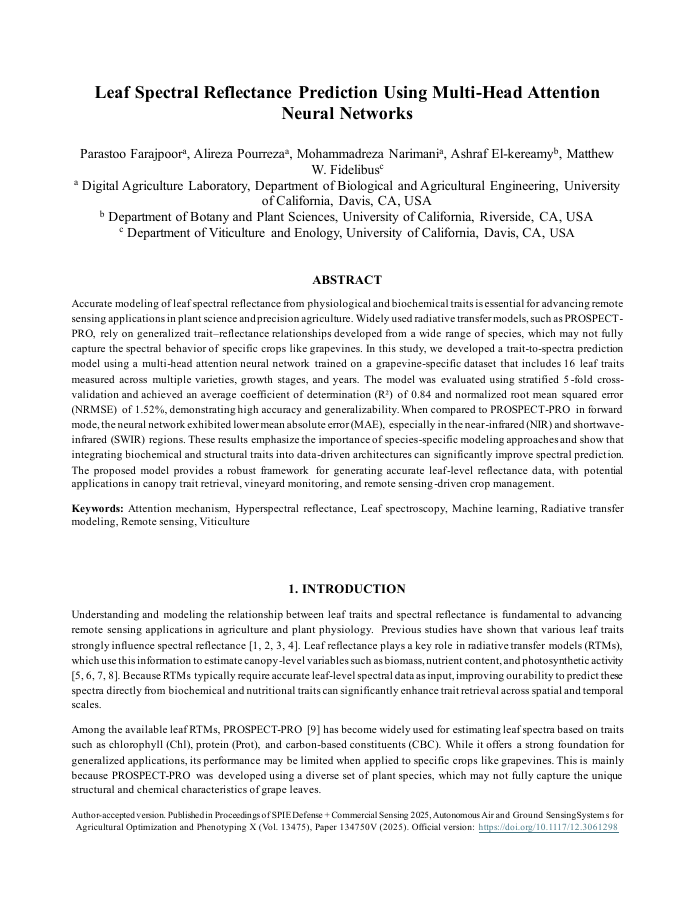
Accurate modeling of leaf spectral reflectance from physiological and biochemical traits is essential for advancing remote sensing applications in plant science and precision agriculture. Widely used radiative transfer models, such as PROSPECT-PRO, rely on generalized trait-reflectance relationships developed from a wide range of species, which may not fully capture the spectral behavior of specific crops like grapevines. In this study, we developed a trait-to-spectra prediction model using a multi-head attention neural network trained on a grapevine-specific dataset that includes 16 leaf traits measured across multiple varieties, growth stages, and years. The model was evaluated using stratified 5-fold cross-validation and achieved an average coefficient of determination (R^2) of 0.84 and normalized root mean squared error (NRMSE) of 1.52 percent, demonstrating high accuracy and generalizability. When compared to PROSPECT-PRO in forward mode, the neural network exhibited lower mean absolute error (MAE), especially in the near-infrared (NIR) and shortwave-infrared (SWIR) regions. These results emphasize the importance of species-specific modeling approaches and show that integrating biochemical and structural traits into data-driven architectures can significantly improve spectral prediction. The proposed model provides a robust framework for generating accurate leaf-level reflectance data, with potential applications in canopy trait retrieval, vineyard monitoring, and remote sensing-driven crop management.
Leaf Spectral Reflectance Prediction Using Multi-Head Attention Neural Networks
Accurate modeling of leaf spectral reflectance from physiological and biochemical traits is essential for advancing remote sensing applications in plant science and precision agriculture.
- Preview
- Year
- 2026
- Hosting
- Abstract onlyARXIV-DEFAULT
Cite
Notes
Only stored in your browser.
Attribution
- Abstract & full text
- arxiv.org/abs/2606.01432ARXIV-DEFAULT
- TL;DR
- Semantic Scholar