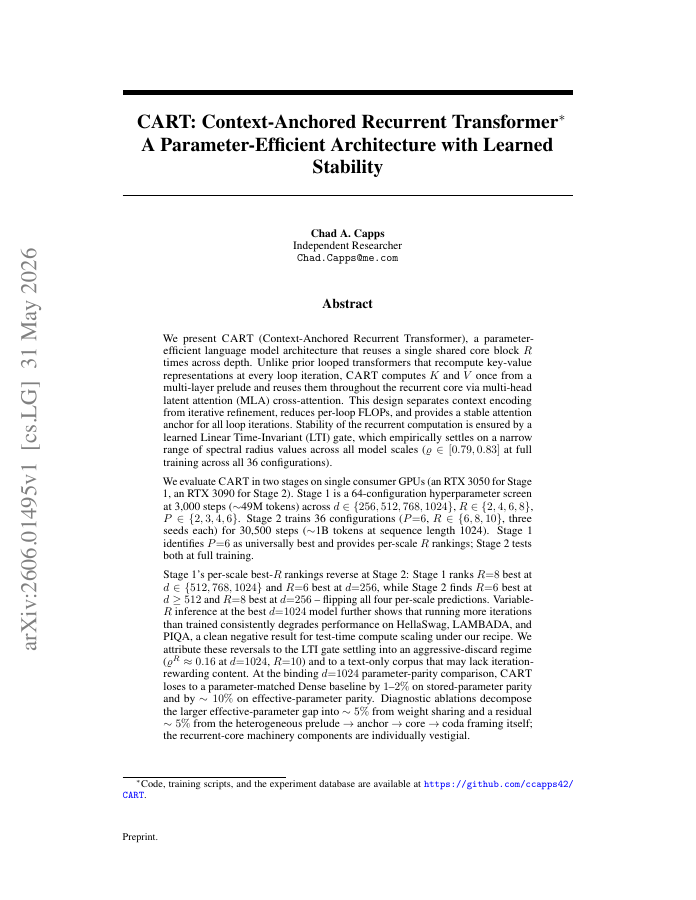
We present CART (Context-Anchored Recurrent Transformer), a parameter-efficient language model that reuses a single shared core block R times across depth. Unlike prior looped transformers that recompute key-value tensors at every iteration, CART computes K and V once from a multi-layer prelude and has the recurrent core cross-attend to those frozen tensors via multi-head latent attention. A learned Linear Time-Invariant (LTI) gate keeps the recurrence stable: its spectral radius settles in a narrow band (rho in [0.79, 0.83]) across all 36 fully-trained configurations. We evaluate CART on single consumer GPUs in two stages: a 64-configuration screen at 3,000 steps, then 36 configurations (P=6, R in {6,8,10}, three seeds) trained for 30,500 steps (~1B tokens). Two patterns hold across widths d in {256,512,768,1024}: prelude depth P dominates loop count R, and the Stage-1 ranking of R reverses at full training (R=6 becomes best at d>=512). At the binding d=1024 parameter-parity test, CART does not beat a parameter-matched dense baseline, losing by 1-2% at stored-parameter parity and by ~10% at effective-parameter parity. Diagnostic ablations split the effective-parameter gap into ~5% from weight sharing and a residual ~5% from the heterogeneous prelude/anchor/core/coda framing; the recurrent-core machinery (hyper-connections, LTI gate, loop-index embedding) is individually vestigial. Variable-R inference degrades on both sides of the trained R, a negative result for test-time depth scaling under this recipe.
CART: Context-Anchored Recurrent Transformer -- A Parameter-Efficient Architecture with Learned Stability
We present CART (Context-Anchored Recurrent Transformer), a parameter-efficient language model that reuses a single shared core block R times across depth. Unlike prior looped transformers that recompute key-value tensors at every iteration, CART computes K and V once from a…
- Preview
- Year
- 2026
- Hosting
- Full text hostedCC-BY-4.0
Cite
Notes
Only stored in your browser.
Attribution
- Abstract & full text
- arxiv.org/abs/2606.01495CC-BY-4.0
- TL;DR
- Semantic Scholar