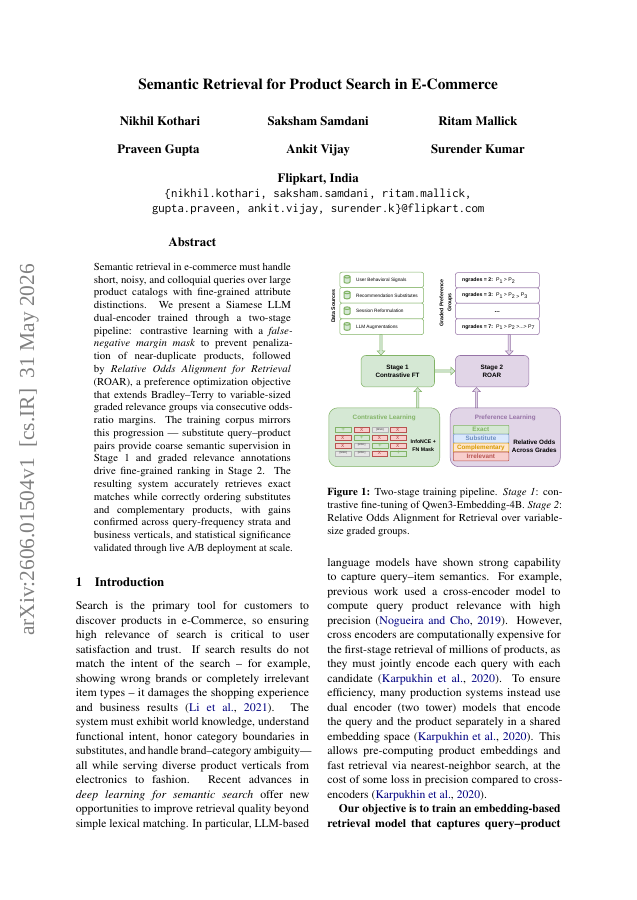
Semantic retrieval in e-commerce must handle short, noisy, and colloquial queries over large product catalogs with fine-grained attribute distinctions. We present a Siamese LLM dual-encoder trained through a two-stage pipeline: contrastive learning with a false-negative margin mask to prevent penalization of near-duplicate products, followed by Relative Odds Alignment for Retrieval (ROAR), a preference optimization objective that extends Bradley-Terry to variable-sized graded relevance groups via consecutive odds-ratio margins. The training corpus mirrors this progression - substitute query-product pairs provide coarse semantic supervision in Stage 1 and graded relevance annotations drive fine-grained ranking in Stage 2. The resulting system accurately retrieves exact matches while correctly ordering substitutes and complementary products, with gains confirmed across query-frequency strata and business verticals, and statistical significance validated through live A/B deployment at scale.
Semantic Retrieval for Product Search in E-Commerce
Semantic retrieval in e-commerce must handle short, noisy, and colloquial queries over large product catalogs with fine-grained attribute distinctions. We present a Siamese LLM dual-encoder trained through a two-stage pipeline: contrastive learning with a false-negative margin…
- Preview
- Year
- 2026
- Hosting
- Excerpt onlyCC-BY-NC-4.0
Cite
Notes
Only stored in your browser.
Attribution
- Abstract & full text
- arxiv.org/abs/2606.01504CC-BY-NC-4.0
- TL;DR
- Semantic Scholar