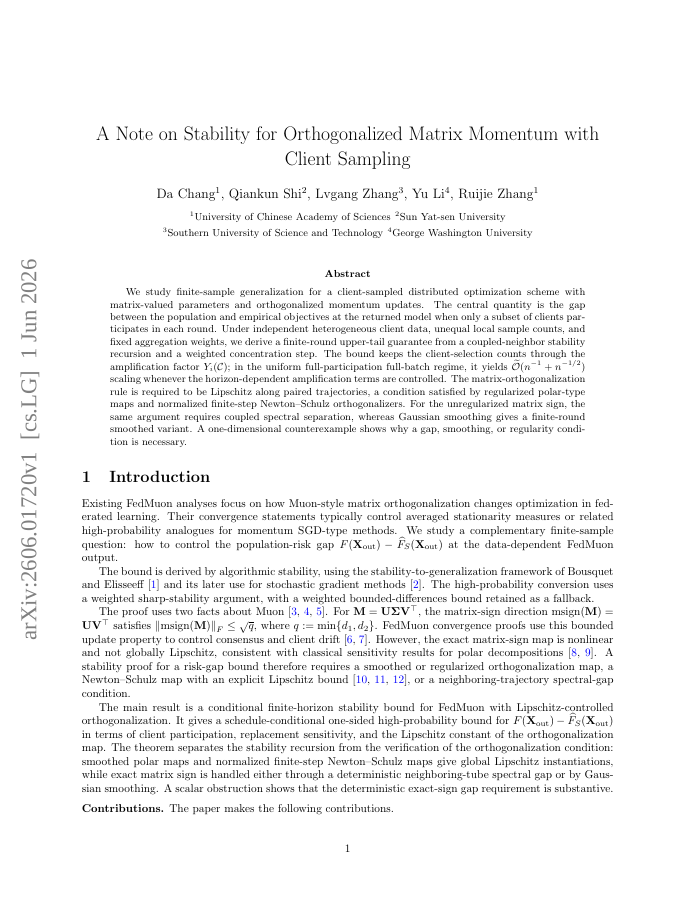
We study finite-sample generalization for a client-sampled distributed optimization scheme with matrix-valued parameters and orthogonalized momentum updates. The central quantity is the gap between the population and empirical objectives at the returned model when only a subset of clients participates in each round. Under independent heterogeneous client data, unequal local sample counts, and fixed aggregation weights, we derive a finite-round upper-tail guarantee from a coupled-neighbor stability recursion and a weighted concentration step. The bound keeps the client-selection counts through the amplification factor Y_i(\mathcal C); in the uniform full-participation full-batch regime, it yields \widetilde{\mathcal O}(n^{-1}+n^{-1/2}) scaling whenever the horizon-dependent amplification terms are controlled. The matrix-orthogonalization rule is required to be Lipschitz along paired trajectories, a condition satisfied by regularized polar-type maps and normalized finite-step Newton--Schulz orthogonalizers. For the unregularized matrix sign, the same argument requires coupled spectral separation, whereas Gaussian smoothing gives a finite-round smoothed variant. A one-dimensional counterexample shows why a gap, smoothing, or regularity condition is necessary.
A Note on Stability for Orthogonalized Matrix Momentum with Client Sampling
We study finite-sample generalization for a client-sampled distributed optimization scheme with matrix-valued parameters and orthogonalized momentum updates. The central quantity is the gap between the population and empirical objectives at the returned model when only a subset…
- Preview
- Year
- 2026
- Hosting
- Abstract onlyARXIV-DEFAULT
Cite
Notes
Only stored in your browser.
Attribution
- Abstract & full text
- arxiv.org/abs/2606.01720ARXIV-DEFAULT
- TL;DR
- Semantic Scholar