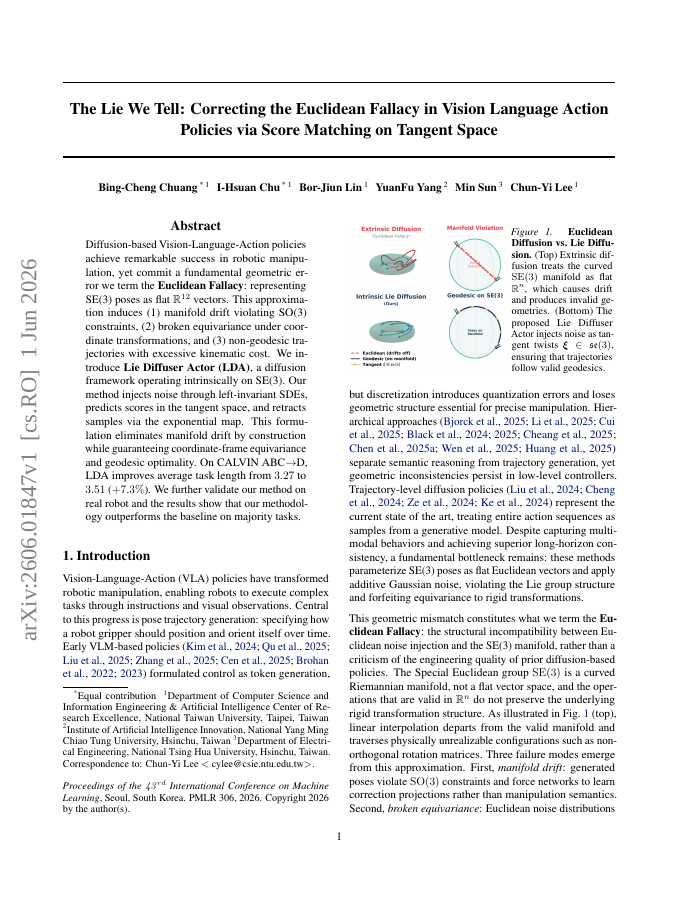
Diffusion-based Vision-Language-Action policies achieve remarkable success in robotic manipulation, yet commit a fundamental geometric error we term the Euclidean Fallacy: representing SE(3) poses as flat \mathbb{R}^{12} vectors. This approximation induces (1) manifold drift violating SO(3) constraints, (2) broken equivariance under coordinate transformations, and (3) non-geodesic trajectories with excessive kinematic cost. We introduce Lie Diffuser Actor (LDA), a diffusion framework operating intrinsically on SE(3). Our method injects noise through left-invariant SDEs, predicts scores in the tangent space, and retracts samples via the exponential map. This formulation eliminates manifold drift by construction while guaranteeing coordinate-frame equivariance and geodesic optimality. On CALVIN ABC\rightarrowD, LDA improves average task length from 3.27 to 3.51 (+7.3%). We further validate our method on real robot and the results show that our methodology outperforms the baseline on majority tasks.
The Lie We Tell: Correcting the Euclidean Fallacy in Vision Language Action Policies via Score Matching on Tangent Space
Diffusion-based Vision-Language-Action policies achieve remarkable success in robotic manipulation, yet commit a fundamental geometric error we term the $\textbf{Euclidean Fallacy}$: representing SE(3) poses as flat $\mathbb{R}^{12}$ vectors.
- Preview
- Year
- 2026
- Hosting
- Abstract onlyARXIV-DEFAULT
Cite
Notes
Only stored in your browser.
Attribution
- Abstract & full text
- arxiv.org/abs/2606.01847ARXIV-DEFAULT
- TL;DR
- Semantic Scholar