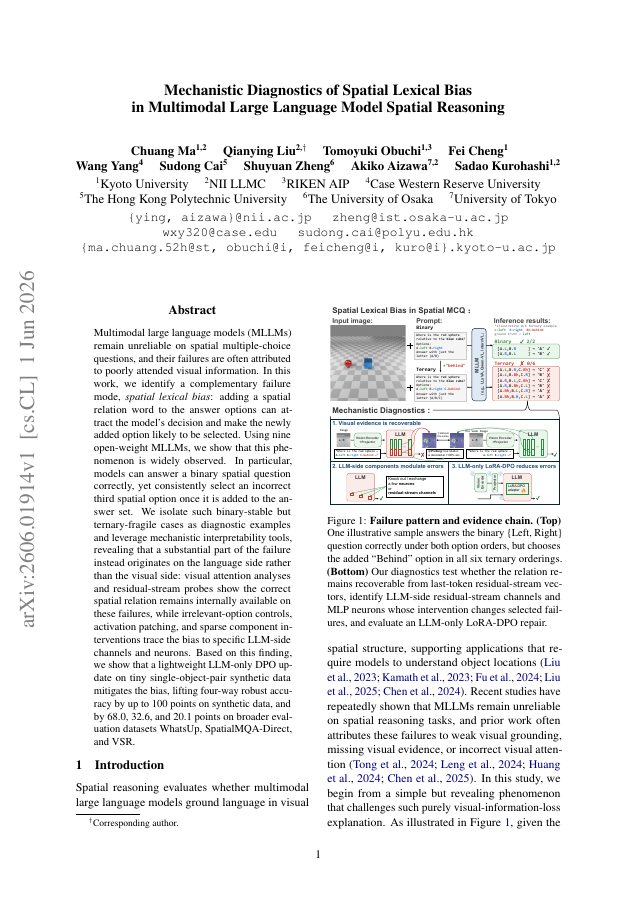
Multimodal large language models (MLLMs) remain unreliable on spatial multiple-choice questions, and their failures are often attributed to poorly attended visual information. In this work, we identify a complementary failure mode, spatial lexical bias: adding a spatial relation word to the answer options can attract the model's decision and make the newly added option likely to be selected. Using nine open-weight MLLMs, we show that this phenomenon is widely observed. In particular, models can answer a binary spatial question correctly, yet consistently select an incorrect third spatial option once it is added to the answer set. We isolate such binary-stable but ternary-fragile cases as diagnostic examples and leverage mechanistic interpretability tools, revealing that a substantial part of the failure instead originates on the language side rather than the visual side: visual attention analyses and residual-stream probes show the correct spatial relation remains internally available on these failures, while irrelevant-option controls, activation patching, and sparse component interventions trace the bias to specific LLM-side channels and neurons. Based on this finding, we show that a lightweight LLM-only DPO update on tiny single-object-pair synthetic data mitigates the bias, lifting four-way robust accuracy by up to 100 points on synthetic data, and by 68.0, 32.6, and 20.1 points on broader evaluation datasets WhatsUp, SpatialMQA-Direct, and VSR.
Mechanistic Diagnostics of Spatial Lexical Bias in Multimodal Large Language Model Spatial Reasoning
Multimodal large language models (MLLMs) remain unreliable on spatial multiple-choice questions, and their failures are often attributed to poorly attended visual information.
- Preview
- Year
- 2026
- Hosting
- Full text hostedCC-BY-4.0
Cite
Notes
Only stored in your browser.
Attribution
- Abstract & full text
- arxiv.org/abs/2606.01914CC-BY-4.0
- TL;DR
- Semantic Scholar