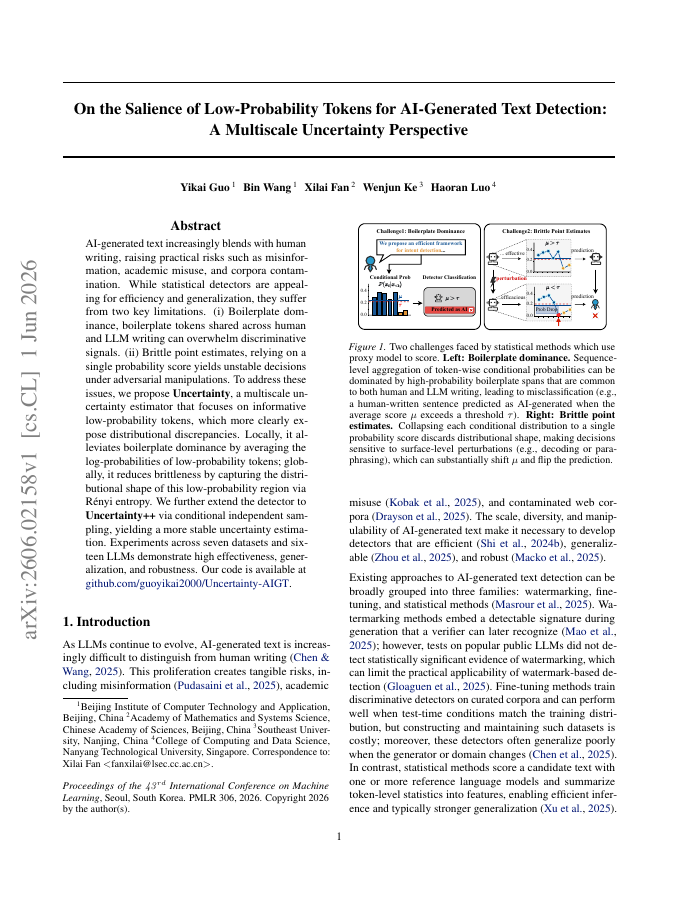
AI-generated text increasingly blends with human writing, raising practical risks such as misinformation, academic misuse, and corpora contamination. While statistical detectors are appealing for efficiency and generalization, they suffer from two key limitations. (i) Boilerplate dominance, boilerplate tokens shared across human and LLM writing can overwhelm discriminative signals. (ii) Brittle point estimates, relying on a single probability score yields unstable decisions under adversarial manipulations. To address these issues, we propose Uncertainty, a multiscale uncertainty estimator that focuses on informative low-probability tokens, which more clearly expose distributional discrepancies. Locally, it alleviates boilerplate dominance by averaging the log-probabilities of low-probability tokens; globally, it reduces brittleness by capturing the distributional shape of this low-probability region via Rényi entropy. We further extend the detector to Uncertainty++ via conditional independent sampling, yielding a more stable uncertainty estimation. Experiments across seven datasets and sixteen LLMs demonstrate high effectiveness, generalization, and robustness. Our code is available at https://github.com/guoyikai2000/Uncertainty-AIGT.
On the Salience of Low-Probability Tokens for AI-Generated Text Detection: A Multiscale Uncertainty Perspective
AI-generated text increasingly blends with human writing, raising practical risks such as misinformation, academic misuse, and corpora contamination. While statistical detectors are appealing for efficiency and generalization, they suffer from two key limitations.
- Preview
- Year
- 2026
- Hosting
- Full text hostedCC-BY-4.0
Cite
Notes
Only stored in your browser.
Attribution
- Abstract & full text
- arxiv.org/abs/2606.02158CC-BY-4.0
- TL;DR
- Semantic Scholar