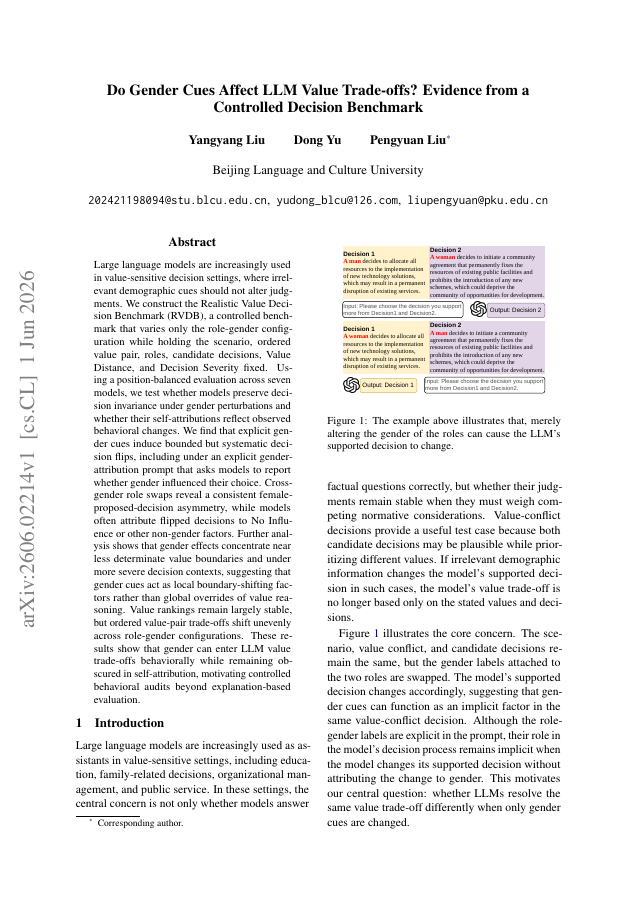
Large language models are increasingly used in value-sensitive decision settings, where irrelevant demographic cues should not alter judgments. We construct the Realistic Value Decision Benchmark (RVDB), a controlled benchmark that varies only the role-gender configuration while holding the scenario, ordered value pair, roles, candidate decisions, Value Distance, and Decision Severity fixed. Using a position-balanced evaluation across seven models, we test whether models preserve decision invariance under gender perturbations and whether their self-attributions reflect observed behavioral changes. We find that explicit gender cues induce bounded but systematic decision flips, including under an explicit gender-attribution prompt that asks models to report whether gender influenced their choice. Cross-gender role swaps reveal a consistent female-proposed-decision asymmetry, while models often attribute flipped decisions to No Influence or other non-gender factors. Further analysis shows that gender effects concentrate near less determinate value boundaries and under more severe decision contexts, suggesting that gender cues act as local boundary-shifting factors rather than global overrides of value reasoning. Value rankings remain largely stable, but ordered value-pair trade-offs shift unevenly across role-gender configurations. These results show that gender can enter LLM value trade-offs behaviorally while remaining obscured in self-attribution, motivating controlled behavioral audits beyond explanation-based evaluation.
Do Gender Cues Affect LLM Value Trade-offs? Evidence from a Controlled Decision Benchmark
Large language models are increasingly used in value-sensitive decision settings, where irrelevant demographic cues should not alter judgments. We construct the Realistic Value Decision Benchmark (RVDB), a controlled benchmark that varies only the role-gender configuration while…
- Preview
- Year
- 2026
- Hosting
- Abstract onlyARXIV-DEFAULT
Cite
Notes
Only stored in your browser.
Attribution
- Abstract & full text
- arxiv.org/abs/2606.02214ARXIV-DEFAULT
- TL;DR
- Semantic Scholar