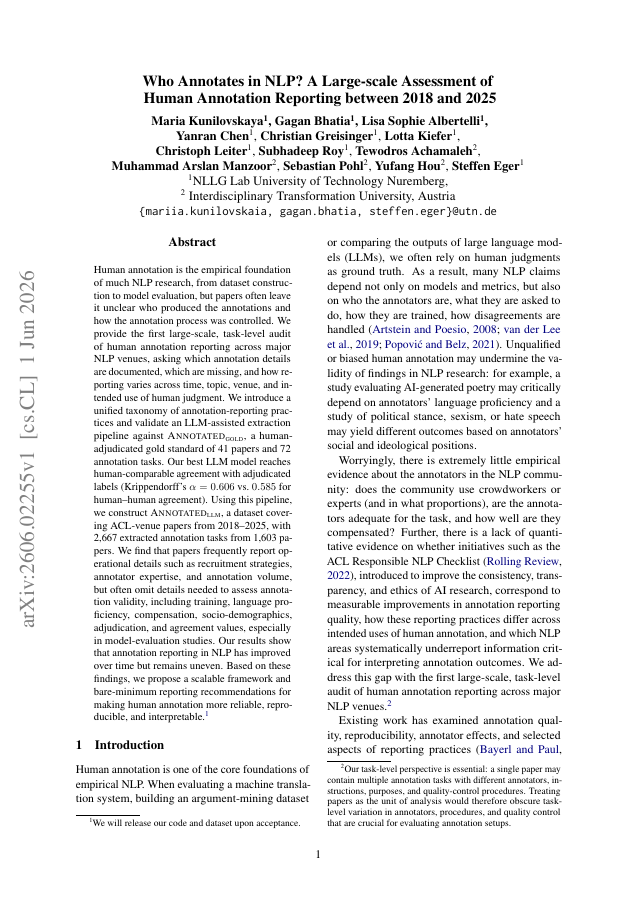
Human annotation is the empirical foundation of much NLP research, from dataset construction to model evaluation, but papers often leave unclear who produced the annotations and how the annotation process was controlled. We provide the first large-scale, task-level audit of human annotation reporting across major NLP venues, asking which annotation details are documented, which are missing, and how reporting varies across time, topic, venue, and intended use of human judgment. We introduce a unified taxonomy of annotation-reporting practices and validate an LLM-assisted extraction pipeline against Annotated-gold, a human-adjudicated gold standard of 41 papers and 72 annotation tasks, where the best model reaches human-comparable agreement with adjudicated labels, with Krippendorff's alpha of 0.606 versus 0.585 for human-human agreement. Using this pipeline, we construct Annotated-llm, a dataset covering ACL-venue papers from 2018-2025, with 2,667 extracted annotation tasks from 1,603 papers, and find that papers frequently report operational details such as recruitment strategies, annotator expertise, and annotation volume, but often omit details needed to assess annotation validity, including training, language proficiency, compensation, socio-demographics, adjudication, and agreement values, especially in model-evaluation studies. Our results show that annotation reporting in NLP has improved over time but remains uneven, and they establish a scalable framework and bare-minimum reporting recommendations for making human annotation more reliable, reproducible, and interpretable.
Who Annotates in NLP? A Large-scale Assessment of Human Annotation Reporting between 2018 and 2025
Human annotation is the empirical foundation of much NLP research, from dataset construction to model evaluation, but papers often leave unclear who produced the annotations and how the annotation process was controlled.
- Preview
- Year
- 2026
- Hosting
- Full text hostedCC-BY-SA-4.0
Cite
Notes
Only stored in your browser.
Attribution
- Abstract & full text
- arxiv.org/abs/2606.02255CC-BY-SA-4.0
- TL;DR
- Semantic Scholar