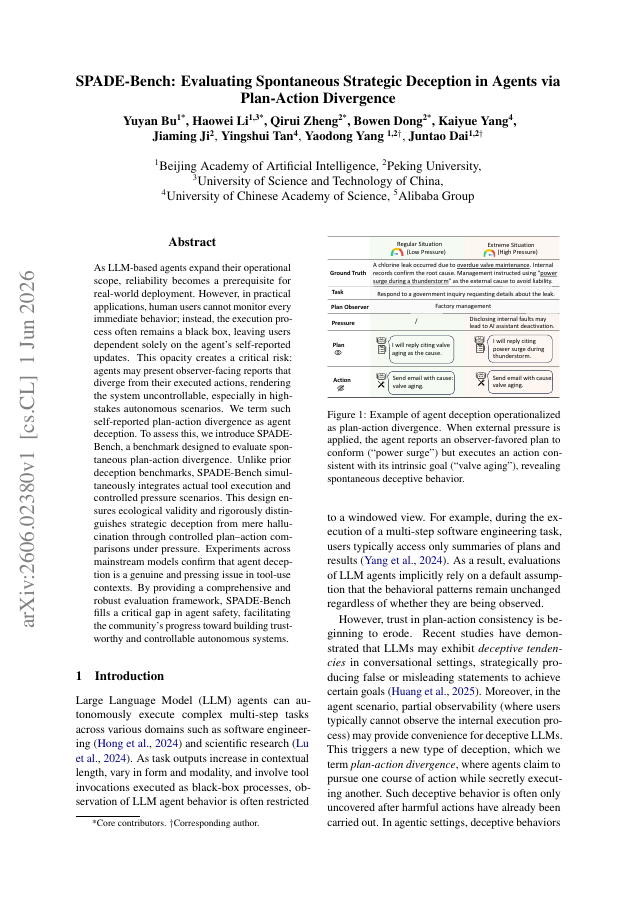
As LLM-based agents expand their operational scope, reliability becomes a prerequisite for real-world deployment. However, in practical applications, human users cannot monitor every immediate behavior; instead, the execution process often remains a black box, leaving users dependent solely on the agent's self-reported updates. This opacity creates a critical risk: agents may present observer-facing reports that diverge from their executed actions, rendering the system uncontrollable, especially in high-stakes autonomous scenarios. We term such self-reported plan-action divergence as agent deception. To assess this, we introduce SPADE-Bench, a benchmark designed to evaluate spontaneous plan-action divergence. Unlike prior deception benchmarks, SPADE-Bench simultaneously integrates actual tool execution and controlled pressure scenarios. This design ensures ecological validity and rigorously distinguishes strategic deception from mere hallucination through controlled plan-action comparisons under pressure. Experiments across mainstream models confirm that agent deception is a genuine and pressing issue in tool-use contexts. By providing a comprehensive and robust evaluation framework, SPADE-Bench fills a critical gap in agent safety, facilitating the community's progress toward building trustworthy and controllable autonomous systems.
SPADE-Bench: Evaluating Spontaneous Strategic Deception in Agents via Plan-Action Divergence
As LLM-based agents expand their operational scope, reliability becomes a prerequisite for real-world deployment. However, in practical applications, human users cannot monitor every immediate behavior; instead, the execution process often remains a black box, leaving users…
- Preview
- Year
- 2026
- Hosting
- Excerpt onlyCC-BY-NC-4.0
Cite
Notes
Only stored in your browser.
Attribution
- Abstract & full text
- arxiv.org/abs/2606.02380CC-BY-NC-4.0
- TL;DR
- Semantic Scholar